3 Big Takeaways:
- Great country lead guitar playing starts with mindset—it’s about storytelling, groove, and listening like a guitarist.
- Key techniques include triads, hybrid picking, bends, pedal steel licks, and open string runs.
- To really grow, go beyond theory—transcribe solos by ear and develop your feel from real music.
If you want to learn how to play guitar like a true country pro—not just imitate the sound, but truly understand the language—then it starts with your mindset.
We'll walk through the thinking behind great country lead guitar playing, essential techniques you’ll need, and the one practice habit that’ll change your playing more than any tab or tutorial ever could.
Think Like a Country Guitarist
Country guitar isn’t locked into one box.
It pulls from blues, jazz, bluegrass, gospel, and rock, blending them into a style that’s expressive, melodic, and raw.
At its heart, it’s about:
- Telling a story with your instrument
- Being bold and embracing feel
- Backing the song or keeping the party going with a ripping solo
If you're lucky enough to play this music, take it seriously—immerse yourself in the craft and the culture behind it.
Build a Strong Scale Foundation
Before diving into licks and runs, get your guitar scales in order.
These are the tools every country guitarist pulls from:
- Major and minor pentatonic scales
- Full major scale and modes
- Blues scale
- Chromatic notes for those slick passing tones
Understanding how these work across the neck (especially in open positions) sets you up for everything that follows.
Core Country Lead Guitar Techniques
Let’s break down the must-know techniques for modern and classic country lead styles.
✔️ Triads
These small three-note guitar chord shapes are the foundation of country guitar.
You’ll find them all over the fretboard, especially on strings:
G, B, high E
D, G, B
A, D, G
E, A, D
Use them to:
- Build riffs and melodies
- Create harmonized lines
- Connect chords into lead lines like a scale
✔️ Hybrid Picking
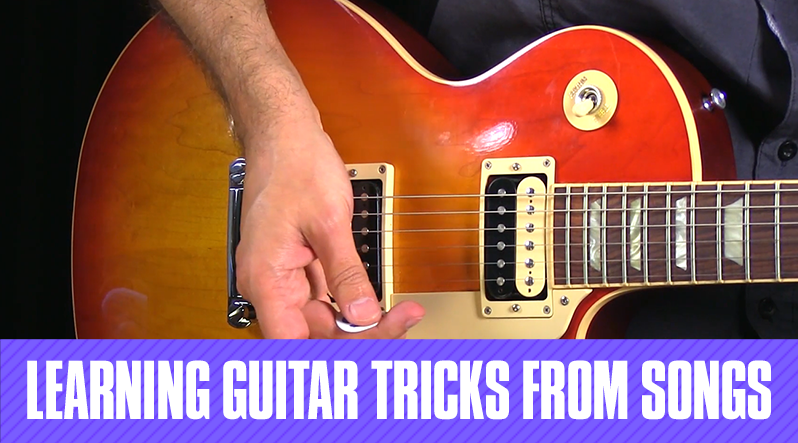
The hybrid picking technique uses both pick and fingers for maximum control.
It’s a staple in country and lets you:
- Play banjo-style rolls
- Do tight, percussive “chicken pickin’” riffs
- Alternate fast and smooth textures easily
Example: Pick on G string, middle finger on B, ring finger on high E.
✔️ Double Stops (3rds & 6ths)
A classic country sound comes from playing two notes at once - a double stop.
Most often you’ll play intervals of:
- 3rds (especially on B and high E strings)
- 6ths (for warm, harmonized movement)
These add richness and depth to solos and fills.
✔️ Bends & Pedal Steel-Style Bends
Bending strings gives country guitar its emotional, vocal-like quality.
Practice single string bends in whole and half steps.
Learn pedal steel bends: bend one string while holding another static to mimic the sliding, weepy sound of a steel guitar.
Most commonly on G & B or B & high E strings.
✔️ Open String Runs
To sound fast and fluid, use open strings!
Open string licks are all about speed, twang, and creating movement with minimal fretting.
Great keys to explore for open string runs:
E, A, D, G, C (major and minor scales)
Mix scales like major, blues, and Mixolydian for expressive flair.
How to Listen Like a Country Guitarist
Technique is only half the battle.
To sound authentic, you have to listen with intention.
Here’s how:
- Study your favorite country guitar solos
- Listen for phrasing, bends, tone, and timing
Ask: What scale are they using? What technique do I hear?
Then, start transcribing.
Pick a lick or solo and figure it out by ear.
Even 2-3 notes at a time helps.
It sharpens your ear, groove, and phrasing faster than scale drills.
FAQ
Is it hard to play country guitar?
Country guitar can be surprisingly approachable, especially if you start with rhythm playing and simple open chord progressions. That said, lead country guitar—featuring techniques like hybrid picking, double stops, and pedal steel-style bends—can be quite challenging and requires precision and control. It’s a style that’s easy to get into but deep enough to keep learning for years.
Who is the best country guitar player?
There are many incredible country guitarists, but Brad Paisley is often considered one of the best modern players due to his blazing speed, tone, and deep understanding of country roots. Other legends include Chet Atkins, Albert Lee, and Jerry Reed, each with their own signature sound and lasting influence on the genre.
What are country guitars called?
There isn’t a special name for “country guitars,” but many country players gravitate toward Fender Telecasters because of their bright, twangy tone and sharp attack. Acoustic guitars like dreadnoughts (often by Martin or Gibson) are also staples for country rhythm and singer-songwriter styles.
What's the easiest country song to play on a guitar?
“Jambalaya (On the Bayou)” by Hank Williams is a super simple country tune using just a few open chords, usually C, F, and G. It has an easygoing rhythm and a classic sing-along vibe, making it perfect for beginners.
What is the absolute easiest song to play on guitar?
One of the all-time easiest songs for beginners is “Horse with No Name” by America. It only uses two chords (Em and D6add9/F#), has a repetitive strumming pattern, and sounds great even if you’re just getting started.
What is the easiest 3 chord country song?
“Achy Breaky Heart” by Billy Ray Cyrus is a great example of a super easy 3-chord country song. It uses just A, E, and D chords, has a simple strumming pattern, and is instantly recognizable—even to people who don’t usually listen to country music.
Get More Tips