Guitar Scales
Scales are the gateway to understanding how to play guitar. Knowing how to play different guitar scales will develop your skill for playing licks, riffs, and solos on guitar. So what is a scale?
Here's a simple definition: a succession of notes played in a certain key determined by its root note.
The foundations of the most famous guitar solos of all time lay in the use of guitar scales. Learning a few or learning the entire list below will certainly improve your technique with guitar and turn you into a shredding superstar.
For the nature of this article, we will illustrate all the scales in the key of A. You can also utilize our scale finder to better understand how these scales work.
Let’s get started!
Minor Pentatonic Scale
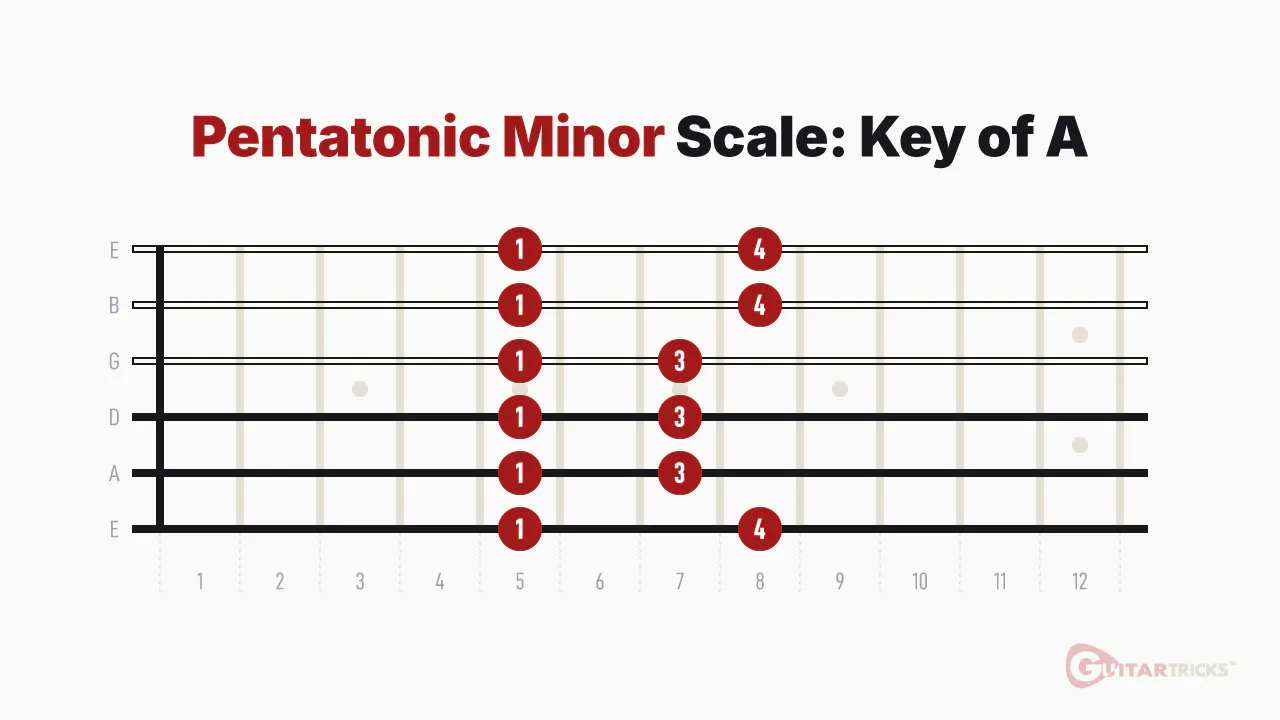
The Minor Pentatonic Scale is the grand master of all scales. It’s one of the two most important guitar scales to have under your fingers. The pentatonic scale uses only five (penta) notes built from the minor scale: 1, b3, 4, 5, and b7 scale degrees. The box pattern helps make this scale easy to play and to remember. Plus, it’s easily moveable up and down the neck making it versatile across gernes. Once you understand this scale, you’ll be able to play across practically any style of music. Learn how to play the minor pentatonic scale in more detail in our Guitar Fundamentals Level 1.
Blues Scale
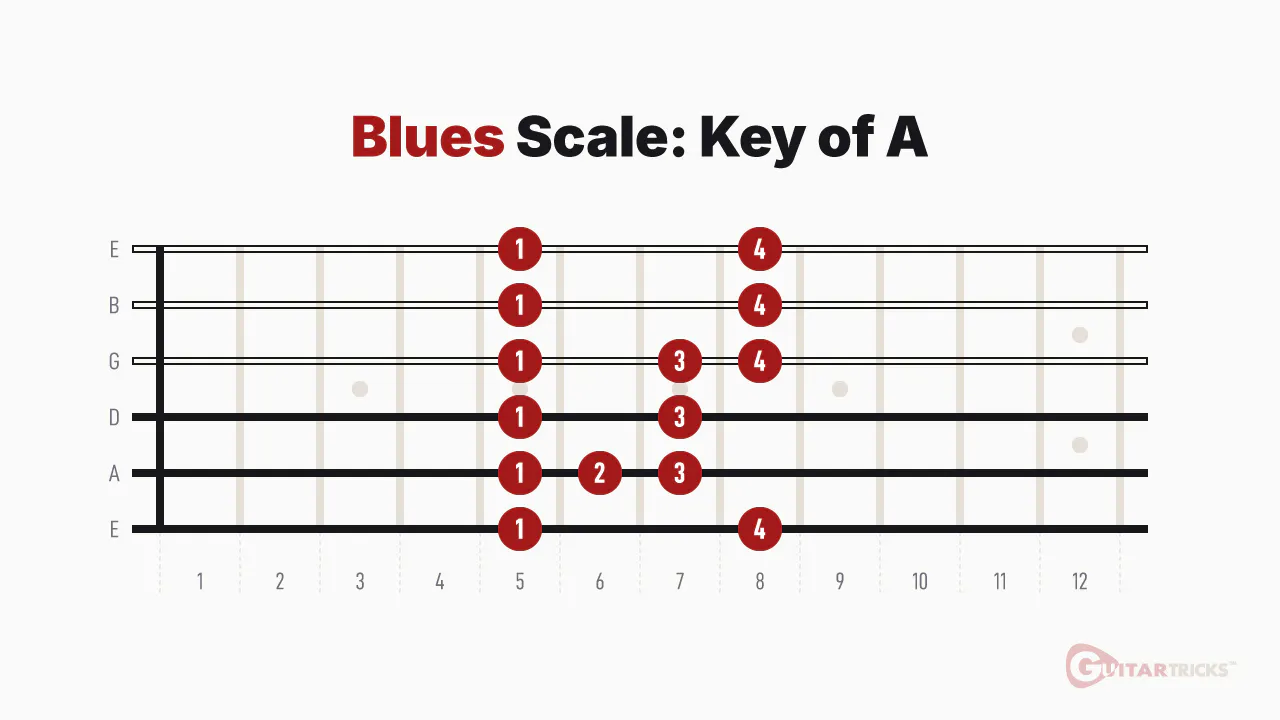
The other most important guitar scale to know is the Blues Scale. The Blues Scale creates a traditional “Blues-y” vibe and sound. It’s a quintessential guitar scale for Blues and Rock music and it can be applied to other styles as well like Pop or Country. To build the Blues scale, it only requires adding one note to either pentatonic scale. From the minor pentatonic scale, add a flat fifth scale degree: 1, b3, 4, b5, 5, b7. From the major pentatonic, add a flat third scale degree: 1, 2, b3, 3, 5, 6. Learn how to play the Blues Scale on guitar step-by-step in our Guitar Fundamentals Course 2.
Major Pentatonic Scale
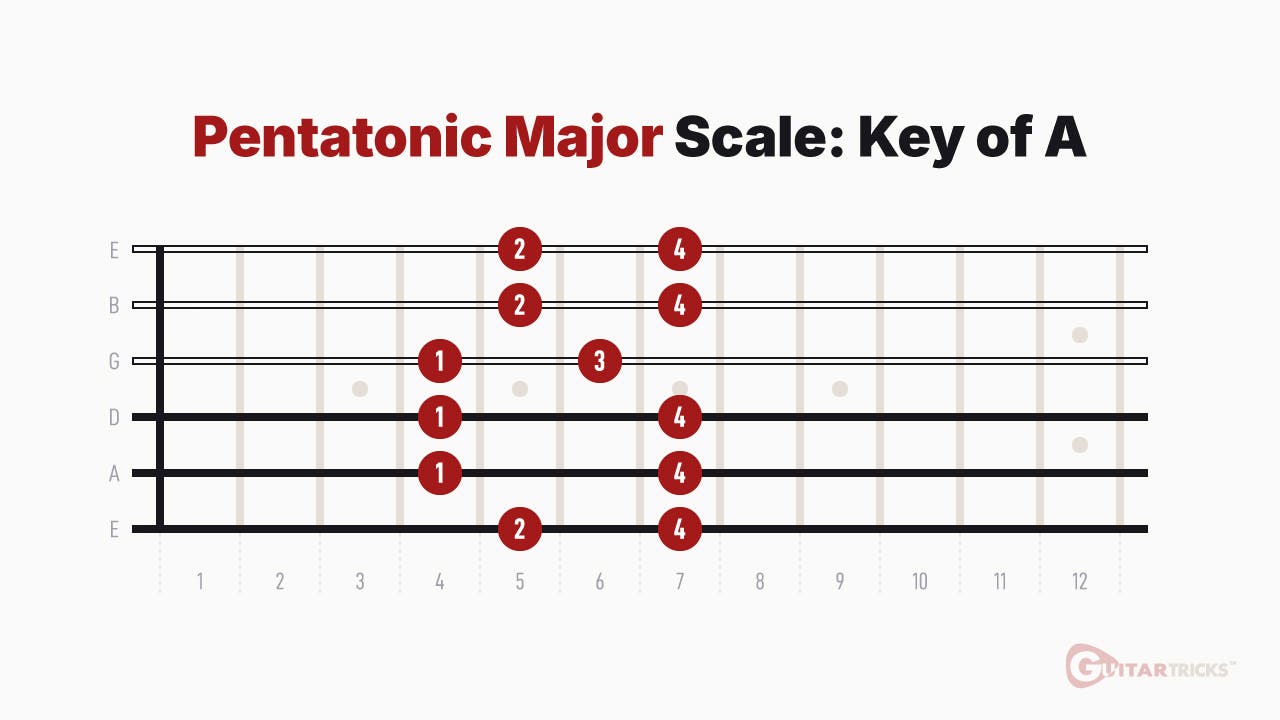
Just like the minor pentatonic, the major pentatonic scale consists of just 5 notes, and built from the major scale. However, instead of containing two flattened notes, it features a simpler arrangement of whole notes: 1, 2, 3, 5, and 6 scale degrees. The major pentatonic is basically a normal major scale minus the 4th and 7th scale degrees. Pro tip: You can shift a pentatonic scale from major to minor by moving the minor pentatonic pattern down three frets or three half steps. Learn how to play the major pentatonic scale in detail in our Rock Style Course.
Major Scale
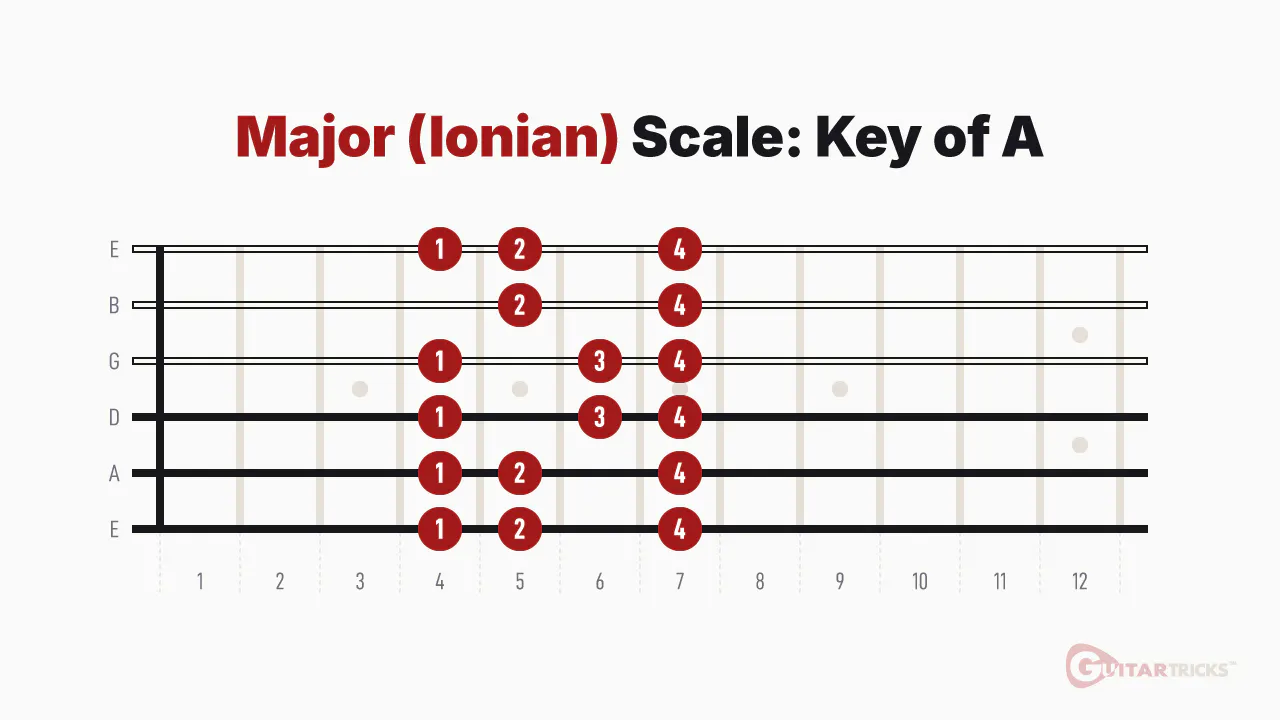
The Major scale on guitar is the most basic scale to learn. Technically a mode called the Ionian scale, this scale is generally the first scale learned by beginner guitar players. (or any instrumentalists for that matter). Simply put, you can play the Ionian/Major scale from the following scale degrees: 1, 2, 3, 4, 5, 6, 7. Simple, right? Another way to think of it is with a whole step/half step formula: W-W-H-W-W-W-H. Learn how to play the Major Scale (Ionian scale) in the Major Scale Pattern Series lesson course.
Natural Minor Scale
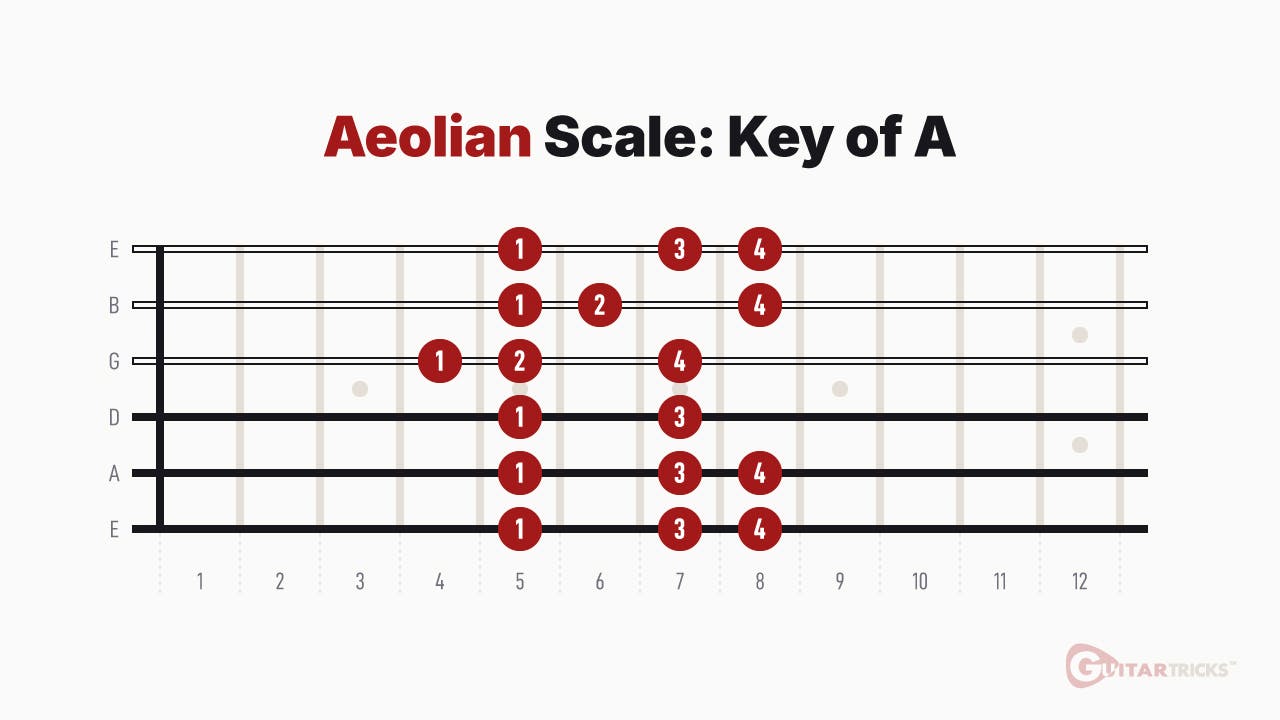
The Aeolian mode guitar scale is also called the ‘natural minor scale.’ Likely the scale you hear the most often besides the Major (Ionian) scale. The Aeolian scale, being the natural minor, consists of the root, major second, minor third, perfect fourth, perfect fifth, minor sixth and minor seventh scale degrees - 1, 2, b3, 4, 5, b6, b7. The above graphic is an example of the A Natural Minor Scale. This scale tends to sound melancholic, or even anthemic if used in the right context. Learn how to play the Aeolian mode in the Minor Scale Pattern Series 1.
Harmonic Minor Scale
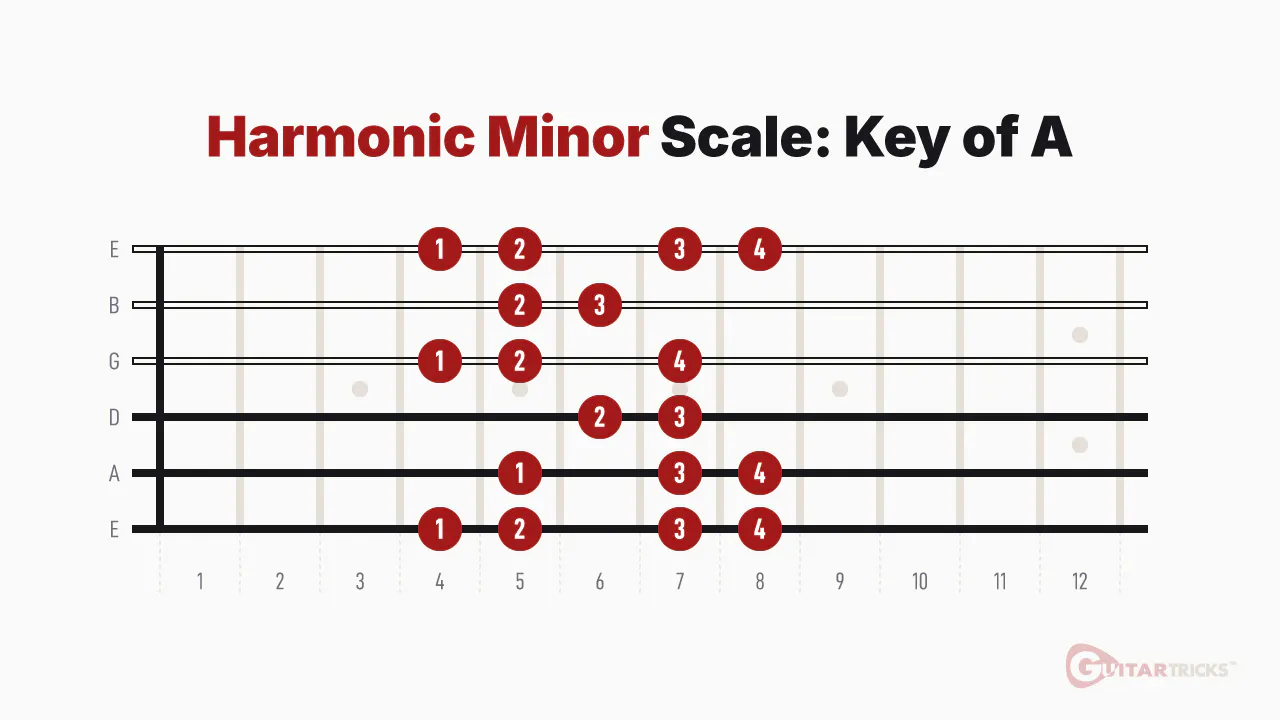
Similar to the natural minor, the Harmonic Minor scale raises that 7th just a half step, leading it to also be known as the “Aeolian #7” scale. This raised 7th is also referred to as a “leading tone” and gives the scale a unique sound. The Harmonic Minor scale is best used when there’s a V7 chord in a minor key. Its minor structure with a raised 7th scale degree creates major-sounding tension within a minor key. This is unique and sounds very interesting. Learn how to play the Harmonic Minor scale on guitar in our Exotic Scale Course.
Melodic Minor Scale
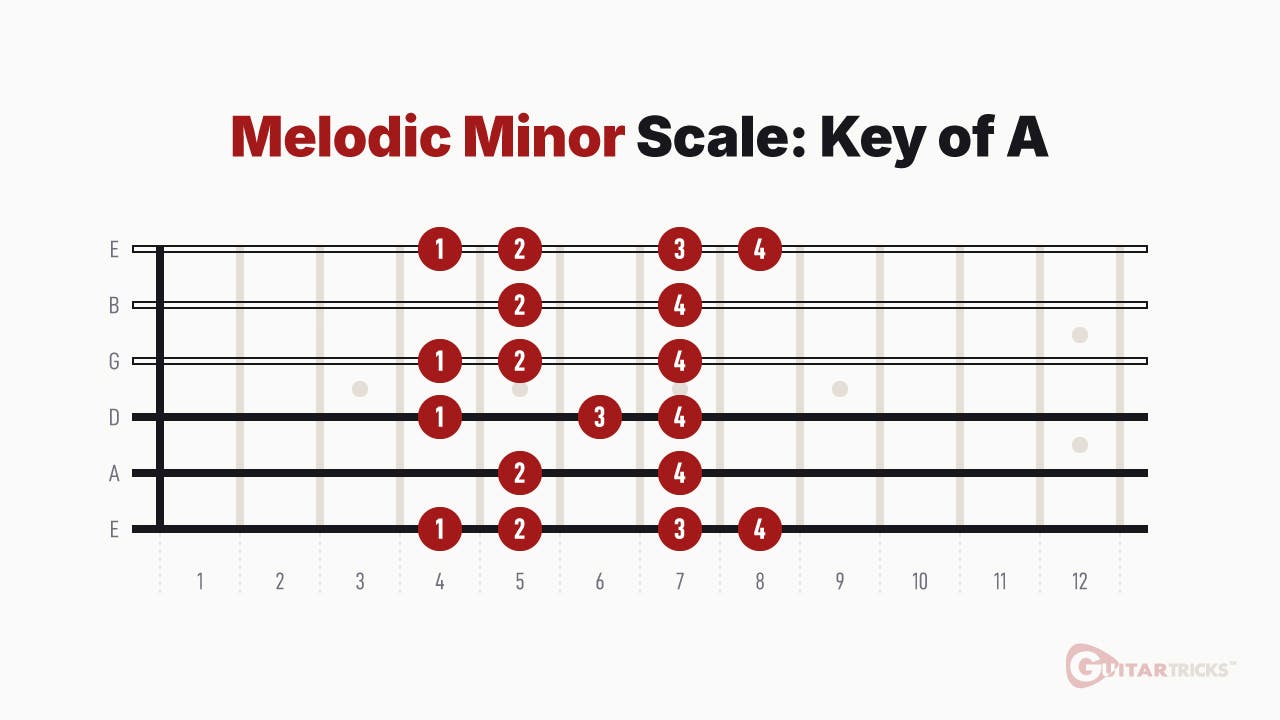
The Melodic Minor Scale, AKA the Jazz Minor Scale, is a minor scale with a natural 6th and 7th - 1, 2, b3, 4, 5, 6, 7. It can also be easily remembered as a major scale pattern with a b3. But let’s keep the focus here to the ‘minor’ aspect of the scale. The Melodic Minor scale on guitar can provide some brightness in sound when playing in a minor key. This is a nuanced scale and is primarily used in Jazz and Classical music. You can learn how to play the Melodic Minor guitar scale in our Exotic Scale Course.
Whole Tone Scale
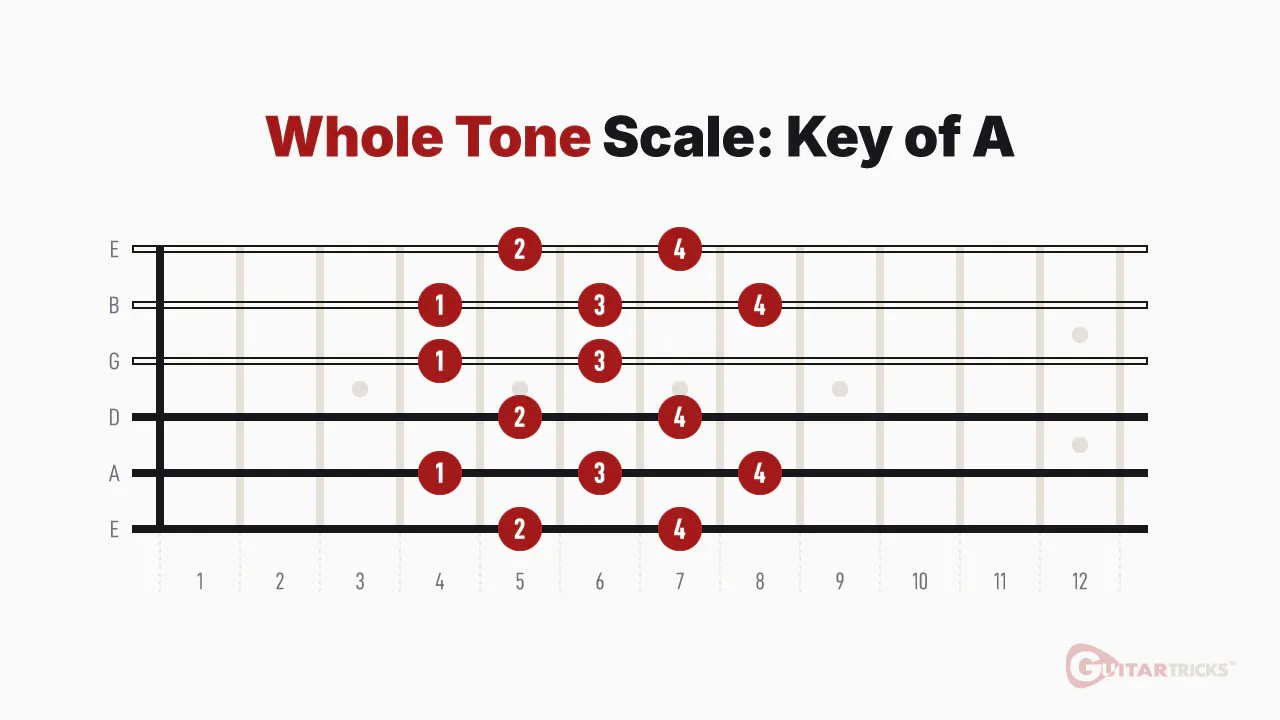
No semitones to be found here! By only using whole steps to build a scale, you get something special – the Whole Tone Scale. Also known as a symmetrical scale, a Whole Tone scale actually only contains six notes. This scale is probably among the rarest in applied music, appearing mostly in harmonies used by Classical impressionist composers or Jazz improvisational composers. Play the diagram above with some guitar effects like reverb or delay and you’ll hear how this scale can sound magical. You can learn how to play other not-so-common scales in the Exotic Guitar Scale course.
Dorian Scale
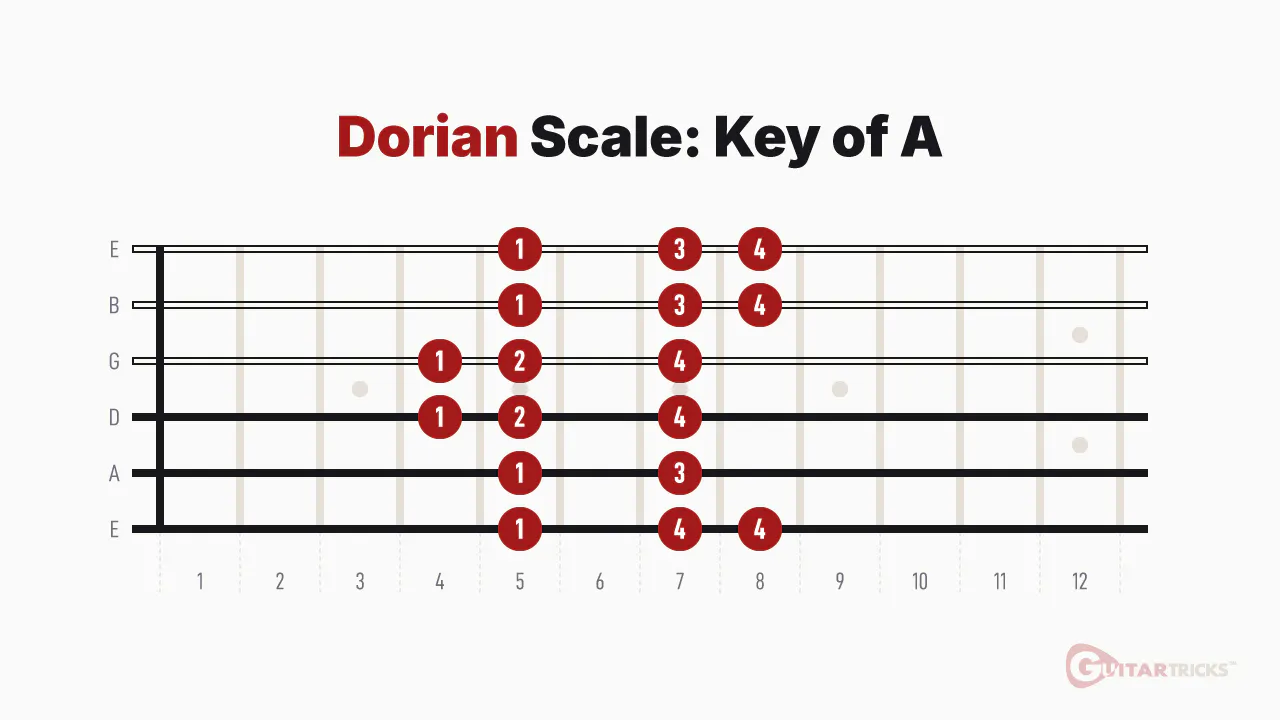
Very popular in jazz, the Dorian mode is also used in Rock and Metal for added complexity. The second out of seven total modes of the major scale, the Dorian is considered a minor mode due to its flattened 3rd and 7th. These minor intervals make it fairly dark-sounding, however it does still have a brightness to it that other minor scales often lack. Learn how to play the Dorian mode on guitar in the Minor Modes Tutorial.
Phrygian Scale
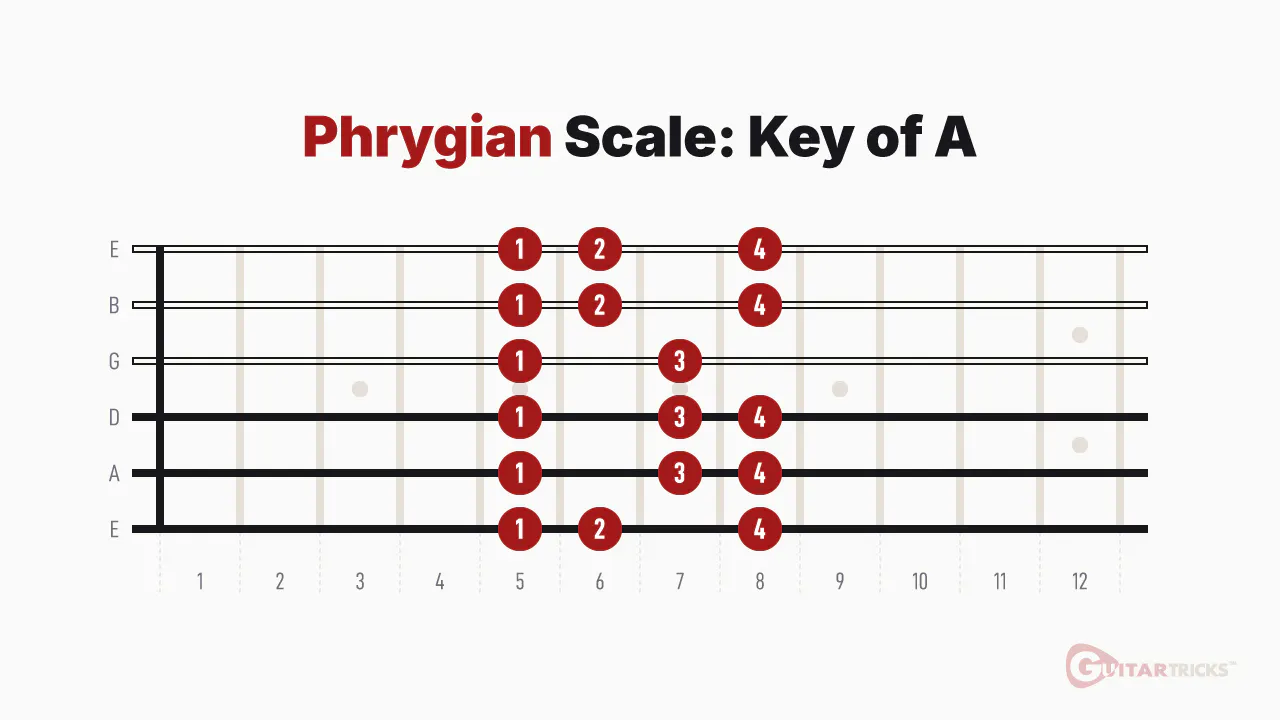
Commonly understood as sounding slightly “Egyptian,” the Phrygian scale is fairly unusual. While it is a mode of the major scale, it is more so a form of minor scale due to its third note being a minor third above the scale’s tonic note. It also contains a minor 6th, 7th and 2nd. This number of flattened notes gives the Phrygian scale a seriously dark sound. Learn how to play the Phrygian mode on guitar in the Minor Modes Tutorial.
Phrygian Dominant Scale
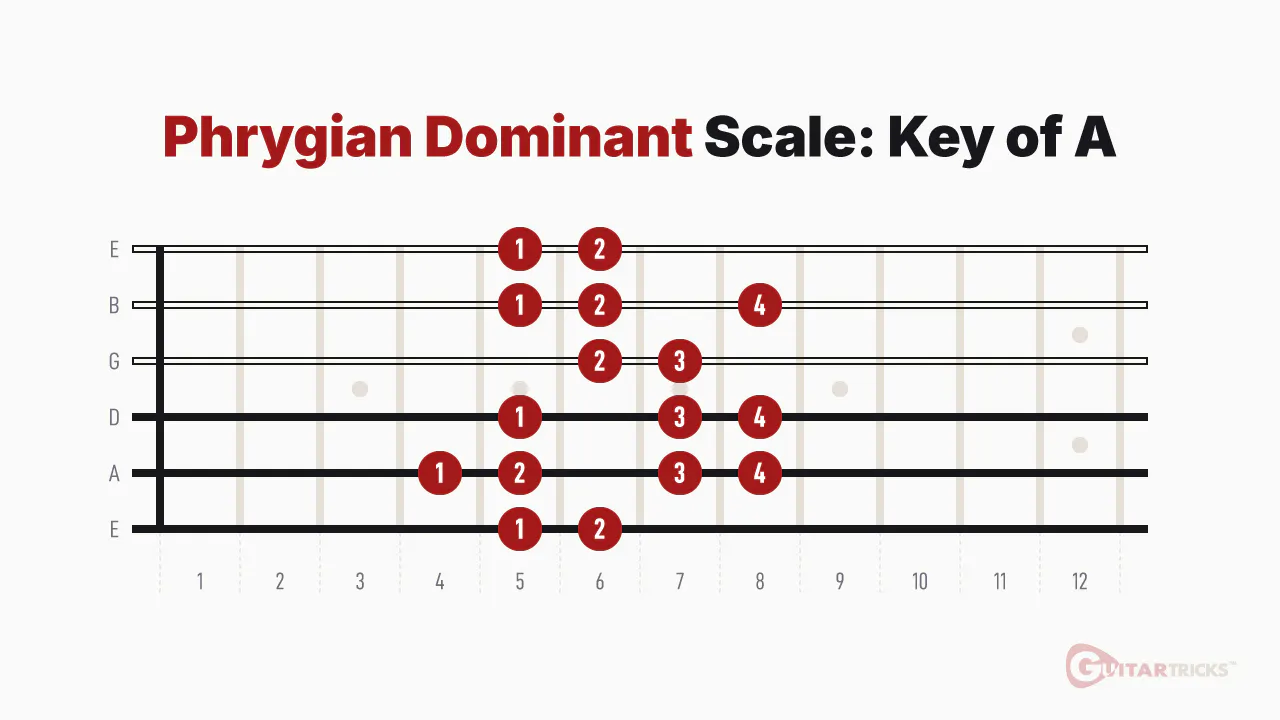
The Phrygian Dominant Scale (1, b2, 3, 4, 5, b6, b7) is based on the 5th mode of the Harmonic Minor scale. You can think of it as a normal Phrygian scale with a raised 3rd. Raising the 3rd scale degree from minor to major gives it a slightly brighter sound making it a go-to for flamenco music. It is also commonly referred to as the Spanish Phrygian scale. Learn how to play the Phrygian Dominant mode on guitar in the Exotic Scale Course.
Lydian Scale
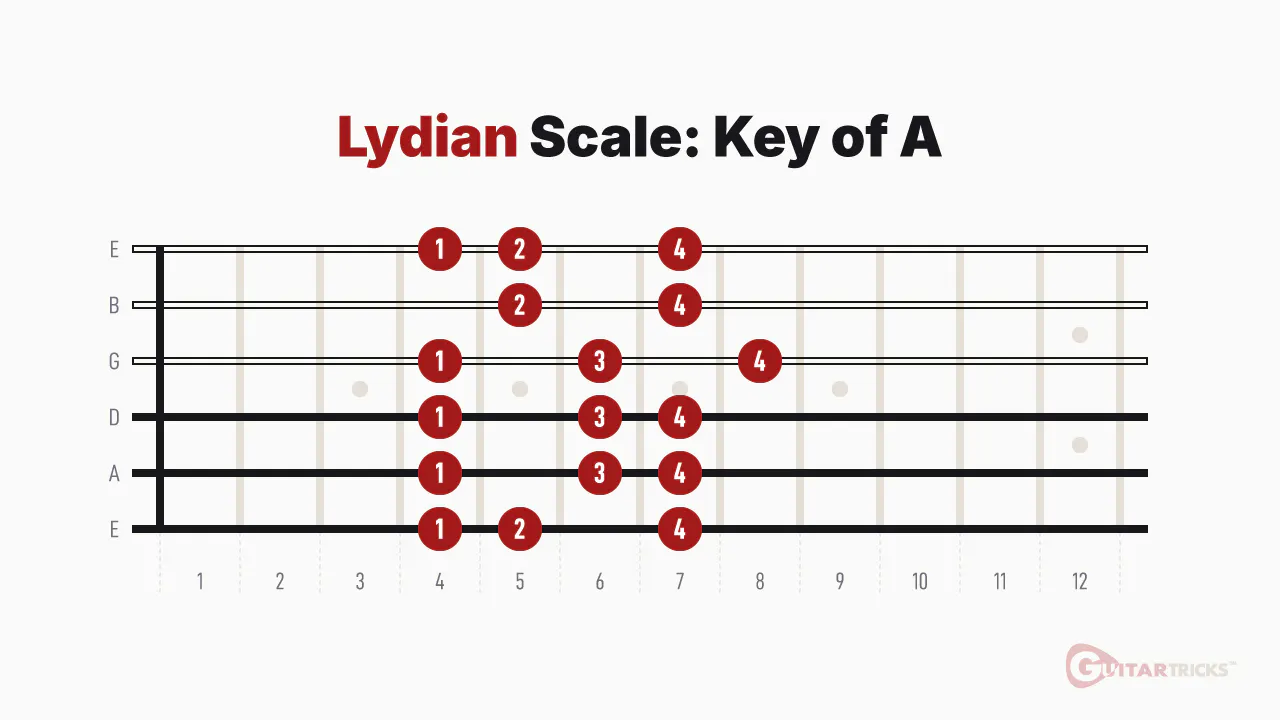
The Lydian mode contains an augmented 4th note giving the scale a brighter sound than a normal major scale. This is the only element that differentiates the Lydian scale from the Ionian (or Major) scale. Songs that employ the Lydian mode usually have a joyous, bright nature due to the scale’s “super major” sound. Learn how to play the Lydian scale on guitar in the Practicing Major Modes tutorial.
Mixolydian Scale
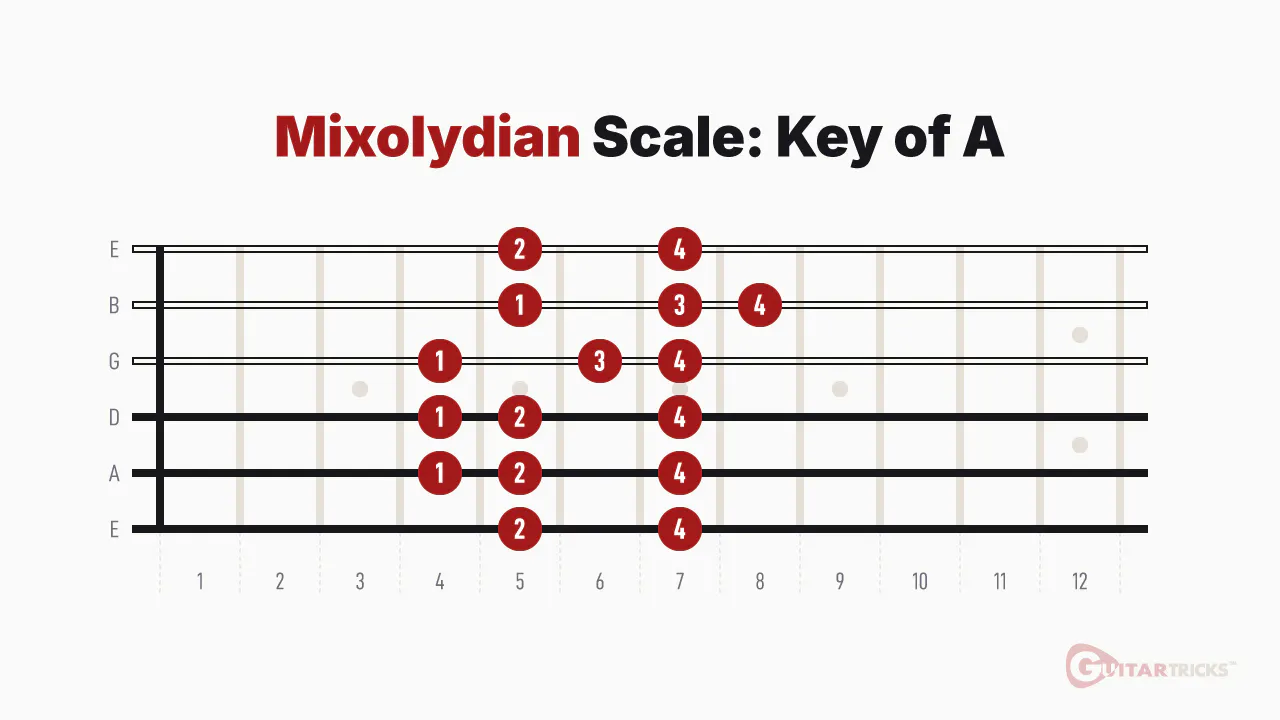
In it's simplest form, the Mixolydian mode is a major scale with a flatted 7th instead of a major 7th: a major scale with a flatted 7th note. The Mixolydian scale can also be called a Dominant Scale due to it being derived from the 5th degree of the major scale: the dominant. The mode sounds great when you are playing over the 5th of a chord. Learn how to play the Mixolydian Mode on guitar in our Major Modes Tutorial.
Locrian Scale
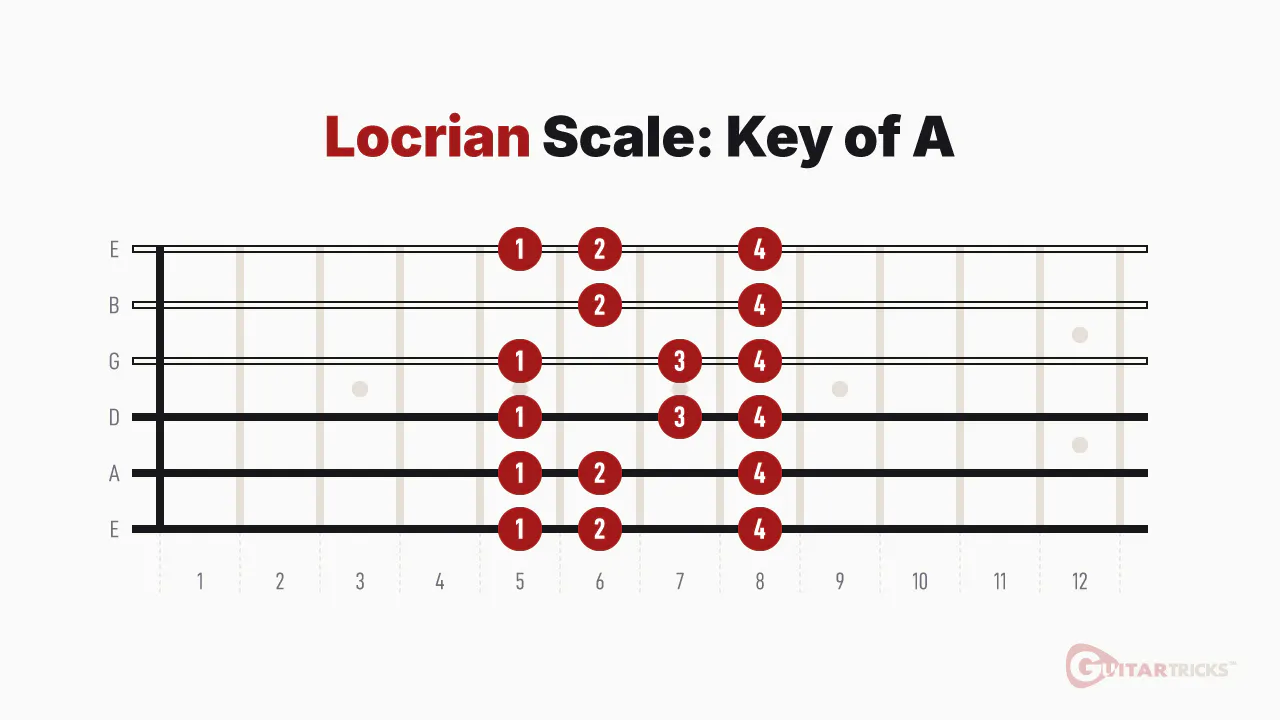
The Locrian scale has a pretty specific sound due to its build: b2, b3, b5, b6 and b7. This scale doesn’t resolve as well as others mentioned here and is not used much in Western music. Still, it’s good to know for expanding your scale vocabulary. The Locrian scale is one of four minor modes -- among Dorian, Aeolian, and Phrygian – and is the only mode to contain a diminished 5th. This scale has quite the sound! Learn how to play all the minor modes, including the Locrian mode on guitar in our Minor Modes Tutorial.
Super Locrian Scale
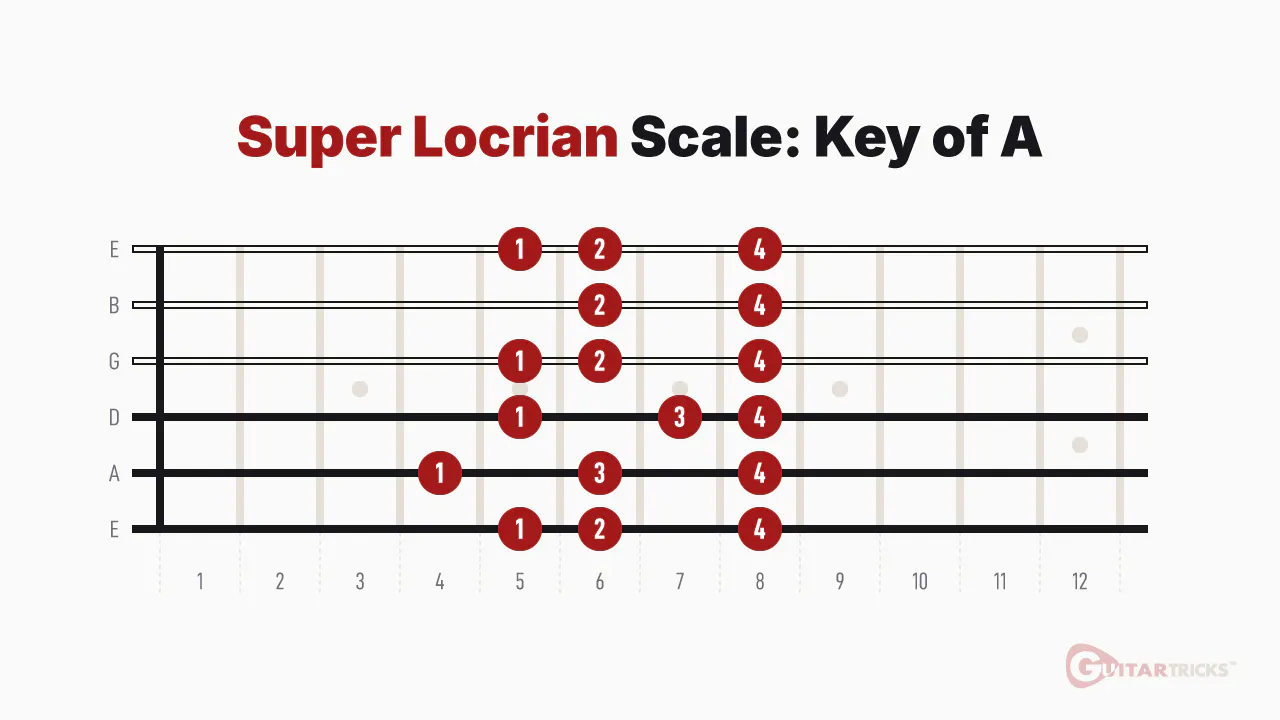
The Super Locrian scale creates a massive amount of dissonance. This scale gives an incredible sense of tension when used, mainly in Jazz and Blues. This altered scale is perfect for jazz-rock fusion & jazz improv. Try playing it over altered dominant 7 chords! Learn how to play all the minor modes, including the Locrian mode on guitar in our Minor Modes Tutorial.
The Best Guitar Scales To Practice
This page is a comprehensive guide to most of the guitar scales you’ll come across. There are different approaches to get these under your fingers. Firstly, start slowly and use a metronome. Work on accurately playing these scales at three tempos; 70bpm, 100bpm, and 120bpm. Work on them ascending and descending, then play them starting on each fret up the neck.
Once you get a couple scales under your hands at a slower tempo, you can start having fun with it! Play around with the notes in the scale and try to come up with some melodies and riffs. Try playing some scales over some jam tracks and get a better feel for how playing solos and melodies works. The more you do this, even at slow tempos, the easier it will get.
You will probably notice that by working through these scales you’ll start seeing how chords are built. If you’re looking for even more scales, or would like to see each of these scales in different keys, head to our Scale Finder for detailed diagrams of each scale.
Scale practice might not be the most romantic part of playing the guitar. But knowing this aspect will speed up your guitar learning exponentially. Scales are the building blocks of playing guitar and of music. Once you get these under your hands, one scale at a time, you’ll be that much closer to rock legend status.
FAQ
Start with the minor pentatonic scale! It's the most popular beginner scale because it's simple, versatile, and perfect for rock, blues, and even pop. Plus, it sounds awesome right away and works with tons of songs.
There are 12 major scales on the guitar (one for each note in music), like C major, G major, D major, and so on. Each major scale also has a matching minor scale (called its relative minor). Together, they form the basis for nearly everything you’ll play!
TThe minor pentatonic is king for riffs. Think of iconic rock, blues, and metal riffs—most of them rely heavily on this scale. Another good one for riffs is the blues scale, which is like the pentatonic with a little extra spice.
Break it down! Focus on one scale shape at a time and practice it all over the fretboard. Play it slowly and make sure you can hear every note. Use backing tracks to make practice more fun. Repetition is key—your fingers will memorize it faster than you think.
Start with just a couple—like the pentatonic and major scales—and master those. Once you're comfortable, you can explore others like the blues scale, harmonic minor, and modes. The truth is, you don’t need to know every scale; just a few can take you far!
The trick is patterns. Guitar scales are built on repeatable shapes and patterns that stay consistent across the fretboard. Practice one shape at a time, and then connect them together like a puzzle. Visualizing how scales overlap will make it all click.
- Minor Pentatonic (the classic beginner scale).
- Major Scale (essential for understanding keys and chords).
- Blues Scale (adds emotion to solos).
- Harmonic Minor (great for classical and metal vibes).
- Explore modes like Dorian or Mixolydian when you're ready to expand.
They focus on muscle memory and patterns. Musicians also associate scales with familiar songs, chord progressions, and feelings. Playing scales over backing tracks makes it easier to hear how they fit into music.
Scales like the melodic minor or diminished scale can be tricky because of their complex intervals and less common usage. But honestly, any scale feels hard until you put in the reps!
Keys like B major or F# major can be tough because they use lots of barre chords and less familiar finger positions. But once you get the hang of those, they’re not so scary!
The C major scale is the easiest because it has no sharps or flats. On the guitar, the G major scale is also pretty beginner-friendly since it aligns nicely with open strings.
The chromatic scale includes all 12 notes in an octave, moving one fret at a time up or down the neck. It’s like a musical alphabet. While it’s not often used in solos, it’s great for warming up and practicing finger coordination.