Top Takeaways...
1. Natural harmonics are created by lightly touching specific fret points—most commonly the 12th, 7th, and 5th frets—without pressing down.
2. There are multiple types of harmonics—natural and artificial—with each offering unique sound possibilities and techniques.
3. Harmonics enhance both tone and technique, with practical uses in tuning, alternate tunings, and musical expression.
If you have been playing guitar for a little while, you've probably heard of natural harmonics.
Those shimmery, ethereal chiming notes that add contrast to a rhythm part, accent notes to a heavy riff and create screaming divebombs.
Harmonics can be heard in songs by bands like Metallica, Led Zeppelin, The Beatles, and many others.
Here are ten facts you need to know about harmonics, how they work and how they add vibrancy and drama to your playing.
The definition of harmonics
To understand what a harmonic is, we need to define two musical terms: the fundamental of a note and the overtones of a note.
When you play your open E string, for instance, the fundamental of the note is E but you do not only hear the E note.
The result is a cluster of vibrations revolving around a fundamental.
Damping those clusters with a light touch to the string to isolate the individual overtones results in a harmonic: a clear, pure, ringing tone.
Let's be fair, understanding harmonics on guitar isn't the first thing you need to know when learning how to play guitar.
Without getting into too much science and physics, if you pluck a string, you can see it vibrate.
Open string harmonics, also referred to as natural harmonics, are created by placing your finger lightly on a very specific place over the fretwire without pressing down and then striking the string.
The easiest places to produce natural harmonics are at the twelfth, seventh, and fifth frets respectively.
Every string has a harmonic at these three frets.
However, while you can play natural harmonics on every string, you cannot play them at every fret.
Harmonics can be played on both acoustic and electric guitars
On acoustic and classical guitars, harmonics tend to be clean and bell-like, but when played on an electric, particularly if you add some volume and distortion, they can positively scream.
For every guitar there is a perfect spot that will produce harmonics.
Finding that right spot will take some experimenting.
Listen for that louder, clearer harmonic tone.
Let your ear guide you to the right place.
Go deeper in pinch harmonics with our pinch harmonics tutorial.
Harmonics work best on the 12th fret
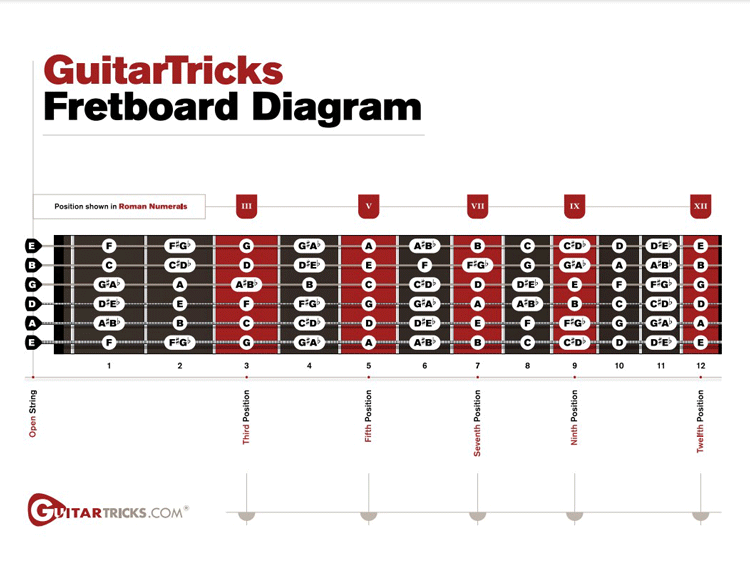
If you are new to harmonics, a good place to begin working with them is the twelfth fret of the high E string, one of the easiest harmonics to execute, especially on an acoustic guitar.
With your fretting hand, lightly touch a finger against the string directly above the twelfth fret, over the fretwire.
Just touch the string slightly, as if you want to mute it.
Don't apply any pressure to the string or press it down as you would to fret a note.
Remember, playing harmonics requires a delicate touch.
Now strike that note with your picking hand and release the string almost simultaneously, letting it vibrate freely.
If executed properly the result should be a bell-like, silvery note.
Again, the most common places to play natural harmonics are at the twelfth, seventh and fifth frets.
If you need to learn more about fretboard notes, check out our fretboard trainer tool.
Once you master playing the harmonic on the twelfth fret, try it again at the seventh fret and then the fifth.
You'll know if you fail to hit the "sweet spot" on the string as it will sound like a muffled note.
Adjust your fingering and try again.
Harmonics exist all over the guitar's fretboard
Natural harmonics are stronger in specific areas of the guitar and occur at exact divisions (nodes) of the length of the vibrating string.
When you use your finger to produce a harmonic, you modify how the string vibrates.
When playing open string harmonics, you divide the string into halves, thirds, fourths, fifths, and sixths.
So playing harmonics at the twelfth fret divides the string in half.
Playing at the seventh or nineteenth fret divides the string into thirds.
Playing at the fifth or twenty-fourth fret divides the string into fourths and so on.
You will notice that the harmonics at the seventh and nineteenth frets and the ones at the fifth and twenty-fourth frets are exactly the same notes.
You can even play guitar chords all with harmonics.
Harmonic notes are the same as fretted notes
Playing a harmonic at the twelfth fret produces the same note that you would normally get by playing the fretted note at the twelfth fret.
The note at the twelfth fret of the high E string is E, which is one octave higher than the note of the open E string.
The harmonic at the twelfth fret of the high E string is that same E, but with the specific overtone of the harmonic.
At the seventh fret, the harmonics are pitched one octave higher than the notes regularly found at the seventh fret.
The harmonic at the seventh fret of the high E string, for example, is the B note found at the nineteenth fret of the high E string.
At the fifth fret the natural harmonics are an octave higher than those found at the twelfth fret.
The harmonic at the fifth fret of the high E string is E, but it is two octaves higher than the note of the open E string.
If your guitar had twenty-four frets, that's where you'd find the matching note for this harmonic.
There are multiple ways to play harmonics
There are two types of harmonics: natural, which are played on an open string and are the easiest for most guitarists to get the hang of, and artificial, which are played on a fretted string using different picking hand techniques.
Touch harmonics are an artificial harmonics technique.
To play them, fret a note on any string between the first and tenth frets.
Place the index finger of your right hand very lightly at the note twelve frets higher on the same string.
This right hand index finger should be very lightly on the wire of the fret in question and not on the wood.
Keeping both fingers in place, pluck the string with your right hand thumb.
This will generate a harmonic one octave higher than the note being fingered by your left hand.
For example, if you play the note at the fifth fret of the G string, you would use your right hand to gently touch the seventeenth fret of the G string to sound the harmonic.
Tap harmonics are an extension of the tapping technique made popular by Eddie Van Halen.
The note is fretted as usual, but instead of striking the string using your pick or thumb, you use one of your picking hand fingers to "tap" the string against the fret of the guitar at the harmonic position.
Pinch harmonics are perhaps the trickiest to play and will initially involve quite a bit of trial and error.
Start by holding down a note anywhere on the fretboard.
Then, with your picking hand, grip a guitar pick between your thumb and index finger so that it just barely sticks out beneath the bottom of your thumb.
Strike the string and then, almost simultaneously, twist your hand so that your thumb rubs gently against the vibrating string.
The thumb deadens the string immediately after being picked, causing the harmonic to sound.
You want to choke up a bit on your pick so that when you strike the string, it will feel like you're hitting both pick and thumb at the same time.
If you make too much contact with your thumb or are late in applying it, the string will go dead and sound muted.
You can play pinch harmonics on any type of guitar, but they are most easily produced on acoustic and electric guitars.
On an electric, you can also take advantage of your amplifier and various effects to give your pinch harmonics more variety and bite.
Once you have the pinch technique down, play around with the tones and controls on both your guitar and amplifier to experiment further.
You'll be astonished at how powerful a sound you can get with such a light touch on your guitar.
Harmonics move in relation to your root note
If you were to put a capo on the first fret, you would then find the fifth, seventh, and twelfth fret harmonics on the sixth, eighth, and thirteenth frets.
If you put the capo on the third fret, these same harmonics would now be located on the eighth, tenth, and fifteenth frets.
You get the idea.
Alternate tunings also open a whole new world of harmonics.
Changing tuning makes available new sets of harmonics, allowing for a much broader variety to choose from.
An altered guitar tuning such as DADGAD, for instance, will have its unique set of harmonics occurring on exactly the same frets as in standard (or any) tuning.
Harmonics are diamond-shaped notes in notation
Harmonics are represented by diamond-shaped notes in the standard notation and a small dot next to the tablature numbers.
Natural harmonics are indicated with the text "Harmonics" or "Harm." above the tablature.
Artificial harmonics that are articulated with the right hand (or picking hand) include the text "R.H.
Harmonics" or "R.H. Harm." above the tab.
For extended phrases played with right-hand (or picking hand) harmonics, the fretted notes are shown in the tab along with instructions to touch the harmonics twelve frets above the notes.
You can use harmonics to tune your guitar
Tuning your guitar using harmonics is similar to how you tune your guitar using the fifth fret tuning method in the sense that you use notes on different strings as references for the string you are tuning.
This method comes in handy if you don't have a piano or guitar tuner around.
To use harmonics to tune your guitar, first make sure your sixth string E is in tune, assuming you are using standard EADGBE tuning.
You will use the sixth string as the reference string, so if it is off-key, then the rest of your strings will be off-key as well.
Now, follow these steps:
-Play the harmonic on the fifth fret of the sixth string and play the harmonic on the seventh fret of the fifth string. Adjust the tuning pegs on the fifth string until the two chimes match.
-Play the harmonic on the fifth fret of the fifth string and play the harmonic on the seventh fret of the fourth string. Adjust the tuning pegs on the fourth string until the two chimes match.
-Play the harmonic on the fifth fret of the fourth string and play the harmonic on the seventh fret of the third string. Adjust the tuning pegs on the third string until the two chimes match.
-Something a little different here: Play the harmonic on the seventh fret of the sixth string and play the open second string (without harmonics). Adjust the tuning pegs on the second string until the two notes match.
-Resume the pattern by playing the harmonic on the fifth fret of the second string and play the harmonic on the seventh fret of the first string. Adjust the tuning pegs on the first string until the two chimes match.
There are amazing ways to use harmonics
Now that you have some of the basics of playing natural harmonics down, spend some time listening for them in your favorite music.
Below are some songs to help get you started.
See if you can pick out the harmonics.
Notice the ways in which they embellish the music, and think about how you can use harmonics in your tonal palette.
"Roundabout" by Yes
"Yellow Ledbetter" by Pearl Jam
"Barracuda" by Heart
"Sunday Bloody Sunday" by U2
"For What It's Worth" by Buffalo Springfield
"Red Barchetta" by Rush
"Nothing Else Matters" by Metallica
Mastering harmonics is a matter of touch, so it requires more practice (and patience!) than you might think.
Playing the harmonics at the fifth fret will especially require you to be as light on your fingers as possible.
It will also take you a while to develop strong sounding harmonics at both the seventh and fifth frets.
A good way to practice your harmonics is unplugged.
You will barely hear the harmonic, but if you can perform them cleanly without any distortion, imagine what you can do with it!
FAQ
What are harmonics in simple terms?
Harmonics are those clear, bell-like tones you hear when you lightly touch a guitar string at specific points and then pluck it. They isolate the higher overtones of a note, creating a purer, more ringing sound.
What are 1st, 2nd, and 3rd harmonics?
The 1st harmonic is the fundamental note—the pitch you normally hear when you play an open string. The 2nd harmonic is one octave above the fundamental and occurs at the 12th fret, while the 3rd harmonic is an octave and a fifth above, found around the 7th and 19th frets.
What are examples of harmonics?
Examples of harmonics can be found in songs like “Roundabout” by Yes, “Nothing Else Matters” by Metallica, and “Sunday Bloody Sunday” by U2. In each, guitarists use natural harmonics to add shimmer or dramatic effect.
How do you play harmonics on a guitar?
To play a natural harmonic, lightly touch a string directly above a fret (like the 12th, 7th, or 5th), without pressing down, and pluck the string. The key is using a very light touch and quickly lifting your finger after the note rings out.
What causes harmonics on guitar?
Harmonics are caused by touching the string at precise points that divide it into equal vibrating sections, allowing only certain overtones to ring out. This isolates specific frequencies and suppresses others, creating that shimmering sound.
How to tell if a guitar is intonated?
Play the 12th fret harmonic and compare it to the fretted note at the same fret—if they sound the same, your intonation is good. If the fretted note is sharp or flat compared to the harmonic, you may need to adjust the string length at the bridge.
What is the effect of harmonics on a guitar?
Harmonics add texture, color, and a touch of magic to your playing. They can emphasize melody lines, create dramatic effects, or simply make a part sound more atmospheric and expressive.
Get more tips