Top 3 Takeaways
1) Fretboard mastery starts with the natural notes — A, B, C, D, E, F, G — before adding sharps and flats.
2) The “half step/whole step” rule is the key to navigating the neck: E–F and B–C are the only natural half steps; everything else is a whole step.
3) Small, consistent practice—like working one string for five minutes a day—builds long-term guitar fretboard fluency.
How to Master the Guitar Fretboard: A Step-by-Step Guide
If you’ve ever watched a great guitarist effortlessly find the same note in different places on the guitar neck, it almost looks like magic.
But the truth is, it’s not magic at all—it’s fretboard mastery, and it’s something you can learn with the right approach.
In this guide, we’ll break down a systematic method to memorize every note on the guitar fretboard, so you can move beyond basic chords and scale shapes and start truly owning the neck.
You’ll learn the natural notes method, the half step/whole step concept, and some powerful exercises to lock it all in.
Start with the Natural Notes
Before you dive into sharps (#) and flats (♭), it’s best to start with the seven natural notes:
A, B, C, D, E, F, G.
These are your “anchor points” on the fretboard—your roadmap for learning.
Think of them like the main cities on a map: once you know where they are, you can easily find the smaller towns (the sharps and flats) around them.
Pro Tip: The names of your open strings (from thickest to thinnest) are E, A, D, G, B, E. These give you six built-in starting points before you even fret a note.
Understand the Half Step/Whole Step Rule
Here’s the golden rule:
- E to F = Half Step (1 fret)
- B to C = Half Step (1 fret)
- All other natural notes are a Whole Step (2 frets) apart.
This means that if you know a note, you automatically know what’s one fret or two frets away.
For example:
On the low E string, the first fret is F (half step from E).
Two frets after that is G.
This simple pattern repeats everywhere on the neck, no matter which string you’re on.
Test out your fretboard knowledge with our fretboard trainer tool.
Learn the First Three Frets on All Strings
One of the most effective ways to start is by focusing on just the first three frets across all six strings.
This keeps the task manageable and lets you apply the half/whole step concept immediately.
Example — Low E string:
- Open: E
- 1st fret: F (half step)
- 3rd fret: G (whole step from F)
Do the same for each string, saying the notes out loud as you play them.
This reinforces both muscle memory and note recognition.
Once you’re comfortable with the first three frets, it’s time for full-string note mapping.
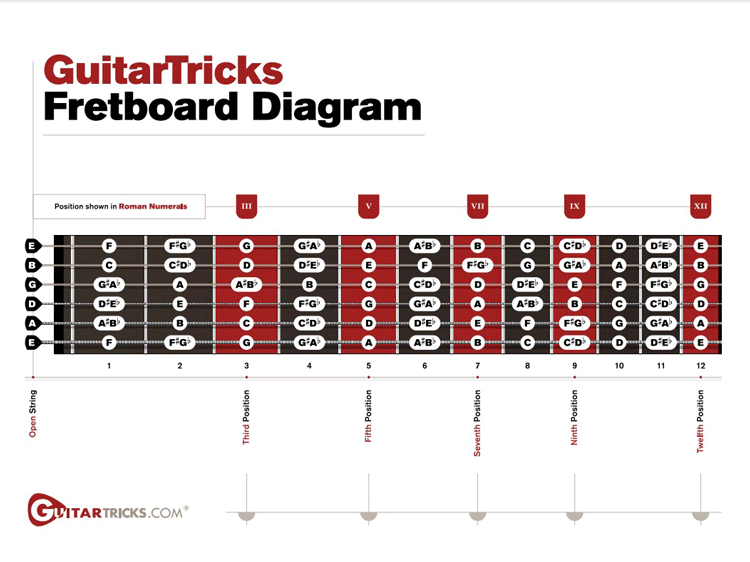
Pick one string and play every note from open to the 12th fret, naming each one out loud.
For example, on the A string:
A (open string) – A# - B – C – C# - D – D# - E – F – F# - G – G# - A (12th fret octave)
Why this works:
You’re training your brain to connect note names with exact fret locations.
You start to see how notes repeat in patterns across the neck.
Reversing the direction makes your brain work harder.
Start from the 12th fret and work down to the open string, naming each note.
This keeps you from only knowing the fretboard in “one direction” and builds confidence for real-world playing situations, like jamming or improvising.
Try String Skips and Pattern Drills
Once you can name notes in order, try string skipping—for example, low E to D string, then to B string—while naming the notes.
Another fun challenge: three-note melodic patterns (play three notes in a row on one string, then shift to another string and repeat).
This not only drills note locations but also helps you think musically while you practice.
If you want to sound like a pro, try naming notes in intervals of a fourth.
This mirrors how many chord progressions move (think jazz, gospel, and rock turnarounds).
Example: Start on C → F → B♭ → E♭ → A♭, etc.
Even if you don’t play the notes as chords, this will boost your theory knowledge and improve your soloing.
Keep Practice Short but Consistent
You don’t need to spend hours a day on this.
Even five minutes of guitar practice a day on one string is enough to make huge progress.
The key is consistency over intensity.
Short, focused sessions prevent burnout.
Daily repetition reinforces memory faster than long, infrequent sessions.
Once you can name notes anywhere on the fretboard, start applying your knowledge in context:
- Find all the A notes in a song.
- Play a riff in one position, then move it to a different area of the neck.
- Identify the notes in a solo you love and see how they connect on the fretboard.
Build Toward Total Fretboard Fluency
Fretboard mastery isn’t about speed—it’s about confidence and awareness.
When you know exactly where a note is, you can play it anywhere, improvise freely, and communicate better with other musicians.
Over time, this skill will:
- Make learning songs faster.
- Improve your ability to play by ear.
- Open up creative options for solos and chord voicings.
Common Mistakes to Avoid
- Skipping the natural notes stage — Jumping into sharps/flats too soon leads to confusion.
- Only learning in one position — Music moves all over the neck; so should you.
- Practicing without saying note names — Thinking and speaking notes cements them in memory.
Final Thoughts
Learning every note on the guitar fretboard is one of the most valuable skills you can develop.
It takes the guitar from being a mystery of memorized shapes to a logical, connected system you can navigate with ease.
With the natural notes as your foundation, the half step/whole step rule as your guide, and consistent practice as your fuel, you’ll soon be able to find any note instantly—no hesitation, no guesswork.
Stick with it, and you won’t just know the fretboard—you’ll own it.
FAQ
How do I memorize the notes on the guitar fretboard quickly?
Start small—learn the natural notes (A, B, C, D, E, F, G) across open strings and the first few frets using the half-step/whole-step rule (only E→F and B→C are half steps; everything else is a whole step). Practice one string at a time, saying the note names out loud, and move on when you can recall them instantly. This builds deep, reliable fretboard fluency—not just pattern recognition.
What’s the best way to learn fretboard note positions—string by string or across all strings?
Begin with a single-string method: walk up and down one string, naming each note. Say them aloud to reinforce both muscle memory and theory understanding. Once comfortable, expand to horizontal patterns across the fretboard to see how note names repeat and link between strings.
Why are E to F and B to C important for fretboard mastery?
E→F and B→C are the only places where natural notes are a half step (one fret) apart—every other natural note is a whole step (two frets) apart. Recognizing this simplifies fretboard navigation—once you understand those little “one-fret moves,” the rest follows naturally.
How does the fretboard repeat, and why does the 12th fret matter?
The guitar’s note layout repeats every 12 frets—the note at the 12th fret is the octave of the open string. So if you play the 12th fret on the low E string, you get an E one octave higher. Many guitars include special position markers (often double dots) at the 12th fret to remind you of this key structural point.
How can I use overlapping strings to learn fretboard layout faster?
Strings overlap: the 5th fret on low E equals the open A string; 5th fret on A = open D; etc. (with a small variation: the G string overlaps the B string at the 4th fret). Use these overlaps to connect note names across strings, reinforcing how fretboard geography links vertically and horizontally.
Is relying on octave shapes or patterns a shortcut or crutch?
While octave patterns and interval shapes (like power chords) are useful for navigating the fretboard, relying solely on them as shortcuts can limit true knowledge. It's better to first learn individual note names fluently, then use patterns to enhance rather than replace your understanding. That way, you're recognizing the note itself—not just a pattern that leads to it.
Get More Tips