Clicky

Ramblings of a mad man


William MG
Full Access
Joined: 03/08/19
Posts: 1,973
William MG
Full Access
Joined: 03/08/19
Posts: 1,973
01/25/2026 12:06 am

This may be a bit long winded, just a word of warning


I just finished guitar practice for the night, and I am both delighted and stymied at the same time. Some of you may know that I use AI – specifically Suno to write the music to the words I write. A wonderful partnership.


So tonight, I am transcribing a song I gave Suno the words to and told it I wanted a blues rocker in F# minor. It came back with a song with One Chord – One. It is polluted with tasty licks throughout using the minor blues scale. I am very happy with what it came up with. It’s a fun song to listen to and fun to play. My frustration lies in the fact that as I transcribe this – I am asking myself: “why can’t I write stuff like this? It’s just a blues scale!!”


Believe me, I do try. But my efforts in licks or song structure are mathematical. Everything makes sense by the numbers, but it is always the same thing. Dull, boring and always sounding the same.


I have said to friends that I think creativity is a gift. You either have it, or you don’t. So why beat ourselves up. I get lots of encouragement from well wishers believing that a breakthrough is just around the corner. At 62, I don’t think so.


Last night my son came over, and we spent some time singing some of the songs I have put together with Suno. A wonderful experience for me. We both sing in the same key and it’s nice to have those harmonies hit.  


And this to me is what music is about – enjoyment. I can write some words, have something – or someone – come up with an arrangement, and get to playing it with friends and family. Have a drink, some laughs, some bs stories – typical stuff when people enjoy time with each other.


This is not to discourage anyone from trying to be creative. Some clearly are. Just not me, not in music anyway. And with whatever time I have left, I want to experience my stories being told through music and being played with others.


Maybe, if you haven’t tried it, you would find it a great way to pull you into guitar. Afterall, as brilliant as the machine is, as of now, it does not provide tabs – and I am ok with that. Helps with ear training.


Bill


This year the diet is definitely gonna stick!

# 1
patagoniadave
Full Access
Joined: 12/17/25
Posts: 54
patagoniadave
Full Access
Joined: 12/17/25
Posts: 54
01/25/2026 4:14 pm

I think there are all types that come to guitar, and their enjoyment will come from different avenues. I will never write music or improvise. I have no desire to play in front of other people, or even to sing. I get a big rush out of making a familiar tune come out of this strange contraption, and that is all I need from it. I am also surprised to find I am interested in the "why" and the music theory.

My right hand and brain seem to be coming along nicely in my journey. My left hand feels like it belongs to another person, and refuses to cooperate, so I read up on left brain vs right brain.

The internet claims that it is a debunked myth, but the idea behind it really resonated with my experience with the guitar so far. 

So, do what brings you joy based on who you are. 


David Martin. 48 year old newbie. Started learning 10/10/2025

Completed: All three versions of Fundamentals 1

Working on: Anders Fundamentals 2

Recording King RO 328 Wide Neck Acoustic

# 2
ChristopherSchlegel
Full Access
Joined: 08/09/05
Posts: 8,834
ChristopherSchlegel
Full Access
Joined: 08/09/05
Posts: 8,834
01/26/2026 4:48 am

Hey, William.  Sounds like you are having fun with it!  Regarding this part: "why can’t I write stuff like this? It’s just a blues scale!!"


In my experience the reason is rhythm.  Specifically rhythmic phrasing.  


It's relatively straightforward to see the notes on the fretboard, to understand the patterns various scales make.  Pentatonic minor & the blues scale are basic and straightforward.  But rhythm is more abstract.  Unless you are reading notation you can't see it.  And even then it's still just a graphic representation.  It's like directions on a map versus actually driving the terrain in real time.  


Some players have a more immediate and intuitive sense of rhythm.  Others have to work at it more to develop it.  But it is something that can be learned and developed.


The first step is to start to think explicitly about rhythmic phrasing.


Most riffs and melodies are made from combinations of 2 to 4 measure phrases with some similarity and variety.  Think of something like the Smoke On The Water riff.  Count it out.  It's basically a simple scale fragment played ascending on downbeats for the first measure, then on the second measure the same notes go up again with a little variation but this time on the upbeats until the end of the measure when the last one lands on the third downbeat again.  Then for the next 2 measures the phrase starts the same but with a different ending landing back on the root on an upbeat.  The repetition with just a little variation, the variations in rhythms is what makes it catchy.


The point here is to think about riffs that are catchy or that you like and count the rhythmic phrasing.  The notes are only one element.  The rhythm is what gives the notes motion, as a musical line happens in time.


It can help to do exercises in which you play a scale trying to make a 1 or 2 measure phrase that sounds good on repeating or looping it.  Don't use the same rhythmic note value the whole time.   Use a combination of quarter notes and eighth notes.  Try to include a variety of notes on the downbeat then the upbeat.  Change the last note of the phrase with second time through.  Aim for simplicity.  Don't try to play too many notes or use the whole scale.  You're trying to make a phrase you might hum or sing, not just play scale notes.


This is the same process that can work to develop a lead guitar vocabulary.  You are learning a language of things to say in a specified time unit.


Keep enjoying what you can do, especially with your kid.  That's the best.  Hope some of that helps!


Christopher Schlegel
Guitar Tricks Instructor
Christopher Schlegel Lesson Directory

# 3
William MG
Full Access
Joined: 03/08/19
Posts: 1,973
William MG
Full Access
Joined: 03/08/19
Posts: 1,973
01/26/2026 1:00 pm
#3 Originally Posted by: ChristopherSchlegel

Hey, William.  Sounds like you are having fun with it!  Regarding this part: "why can’t I write stuff like this? It’s just a blues scale!!"


In my experience the reason is rhythm.  Specifically rhythmic phrasing.  


It's relatively straightforward to see the notes on the fretboard, to understand the patterns various scales make.  Pentatonic minor & the blues scale are basic and straightforward.  But rhythm is more abstract.  Unless you are reading notation you can't see it.  And even then it's still just a graphic representation.  It's like directions on a map versus actually driving the terrain in real time.  


Some players have a more immediate and intuitive sense of rhythm.  Others have to work at it more to develop it.  But it is something that can be learned and developed.


The first step is to start to think explicitly about rhythmic phrasing.


Most riffs and melodies are made from combinations of 2 to 4 measure phrases with some similarity and variety.  Think of something like the Smoke On The Water riff.  Count it out.  It's basically a simple scale fragment played ascending on downbeats for the first measure, then on the second measure the same notes go up again with a little variation but this time on the upbeats until the end of the measure when the last one lands on the third downbeat again.  Then for the next 2 measures the phrase starts the same but with a different ending landing back on the root on an upbeat.  The repetition with just a little variation, the variations in rhythms is what makes it catchy.


The point here is to think about riffs that are catchy or that you like and count the rhythmic phrasing.  The notes are only one element.  The rhythm is what gives the notes motion, as a musical line happens in time.


It can help to do exercises in which you play a scale trying to make a 1 or 2 measure phrase that sounds good on repeating or looping it.  Don't use the same rhythmic note value the whole time.   Use a combination of quarter notes and eighth notes.  Try to include a variety of notes on the downbeat then the upbeat.  Change the last note of the phrase with second time through.  Aim for simplicity.  Don't try to play too many notes or use the whole scale.  You're trying to make a phrase you might hum or sing, not just play scale notes.


This is the same process that can work to develop a lead guitar vocabulary.  You are learning a language of things to say in a specified time unit.


Keep enjoying what you can do, especially with your kid.  That's the best.  Hope some of that helps!

I really appreciate the input Christopher, thank you very much!  I have read this a few times and I think I know what you mean. I am going to put some work into it!


Thanks again


Bill


This year the diet is definitely gonna stick!

# 4
William MG
Full Access
Joined: 03/08/19
Posts: 1,973
William MG
Full Access
Joined: 03/08/19
Posts: 1,973
01/27/2026 3:21 pm

Hi Christopher,


just an update. I am trying what you are referring to and watching my timing and paying closer attention to the timing I am hearing in various songs. I can get that nailed down. The next challenge, and I think this is going to take the most work, is coming up with something "cool and original" - or at least "borrowed and somewhat original". 


I know artist borrow on styles. I have sheets of SRV and Hendrix licks. And I know intelligent people would just borrow some material from the greats and maybe make some adjustments. But I like making things hard on myself. Maybe someday I can come up with a lick that everyone wants to play! 


But in the meantime as I work through this I will remain in awe of the true artist who comes up with licks or riffs that we all want to hear time after time.


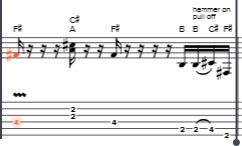
I don't know exactly how the machine works, (AI), it may be totally copying famous licks or maybe doing a bit of copy/modified. Not sure, Just know what it comes up with sounds timeless and totally cool, like the lick below from a song it wrote the music for. This is so simple, but so cool to hear. That is the magic to me and ultimately what I would like to come up with if that is possible. 


Appreciate you supporting all us members!


This year the diet is definitely gonna stick!

# 5
ChristopherSchlegel
Full Access
Joined: 08/09/05
Posts: 8,834
ChristopherSchlegel
Full Access
Joined: 08/09/05
Posts: 8,834
01/28/2026 1:02 pm

Hey, William.  I appreciate the update! 


Artists do indeed reuse licks from those that influence or inspire them.  It's how they use them that gives them a unique, individual & identifiable style.


SRV is a great case in point.  I don't think he ever played a single lick or series of notes that hadn't been played by blues players before him.  You can find the licks he did in the recordings of Lonnie Mack, Johnny Winter, Buddy Guy and all the blues Kings.  But what made him unique is they way he put them together, the tone, the touch, and of course his own rhythmic phrasing.


The lesson here is that you should work on playing or making up riffs and licks that sound like good music to you.  Things that sound cool.  And any originality you find along the way will follow as result of that process.  If you set out with originality in mind as a goal, then you are almost guaranteed to fail because how can you be sure what you played hasn't been played before?  Or that maybe you heard it somewhere before and now you have to figure out if it's completely original or not?  Or just partially original and you might have to adjust the part that was too unoriginal?  And that's just the guitar part.  There's also the bass, drums, the overall song arrangement, and so on.


Just try to play good music.  That's challenge enough!


Regarding the computer program you are using, you have the right basic idea.  It's formed from an input of a large database of existing music, then it uses that as the basis for output based on user input.  I doubt it explicitly copies some existing song's riff.  But I wouldn't be surprised if some output resulted in randomly generated a riff or lick verbatim.  If you tell it you want a blues-rock riff, there are a lot of possibilities but the overall parameters for what would be considered appropriate are programmed to fit well within that genre.


Keep practicing!


edited

Christopher Schlegel
Guitar Tricks Instructor
Christopher Schlegel Lesson Directory

# 6
William MG
Full Access
Joined: 03/08/19
Posts: 1,973
William MG
Full Access
Joined: 03/08/19
Posts: 1,973
01/29/2026 12:44 pm
#6 Originally Posted by: ChristopherSchlegel

Hey, William.  I appreciate the update! 


Artists do indeed reuse licks from those that influence or inspire them.  It's how they use them that gives them a unique, individual & identifiable style.


SRV is a great case in point.  I don't think he ever played a single lick or series of notes that hadn't been played by blues players before him.  You can find the licks he did in the recordings of Lonnie Mack, Johnny Winter, Buddy Guy and all the blues Kings.  But what made him unique is they way he put them together, the tone, the touch, and of course his own rhythmic phrasing.


The lesson here is that you should work on playing or making up riffs and licks that sound like good music to you.  Things that sound cool.  And any originality you find along the way will follow as result of that process.  If you set out with originality in mind as a goal, then you are almost guaranteed to fail because how can you be sure what you played hasn't been played before?  Or that maybe you heard it somewhere before and now you have to figure out if it's completely original or not?  Or just partially original and you might have to adjust the part that was too unoriginal?  And that's just the guitar part.  There's also the bass, drums, the overall song arrangement, and so on.


Just try to play good music.  That's challenge enough!


Regarding the computer program you are using, you have the right basic idea.  It's formed from an input of a large database of existing music, then it uses that as the basis for output based on user input.  I doubt it explicitly copies some existing song's riff.  But I wouldn't be surprised if some output resulted in randomly generated a riff or lick verbatim.  If you tell it you want a blues-rock riff, there are a lot of possibilities but the overall parameters for what would be considered appropriate are programmed to fit well within that genre.


Keep practicing!

Good advice!!


This year the diet is definitely gonna stick!

# 7

Please register with a free account to post on the forum.