#6
Originally Posted by:
DJ_1123
Hi Chris,
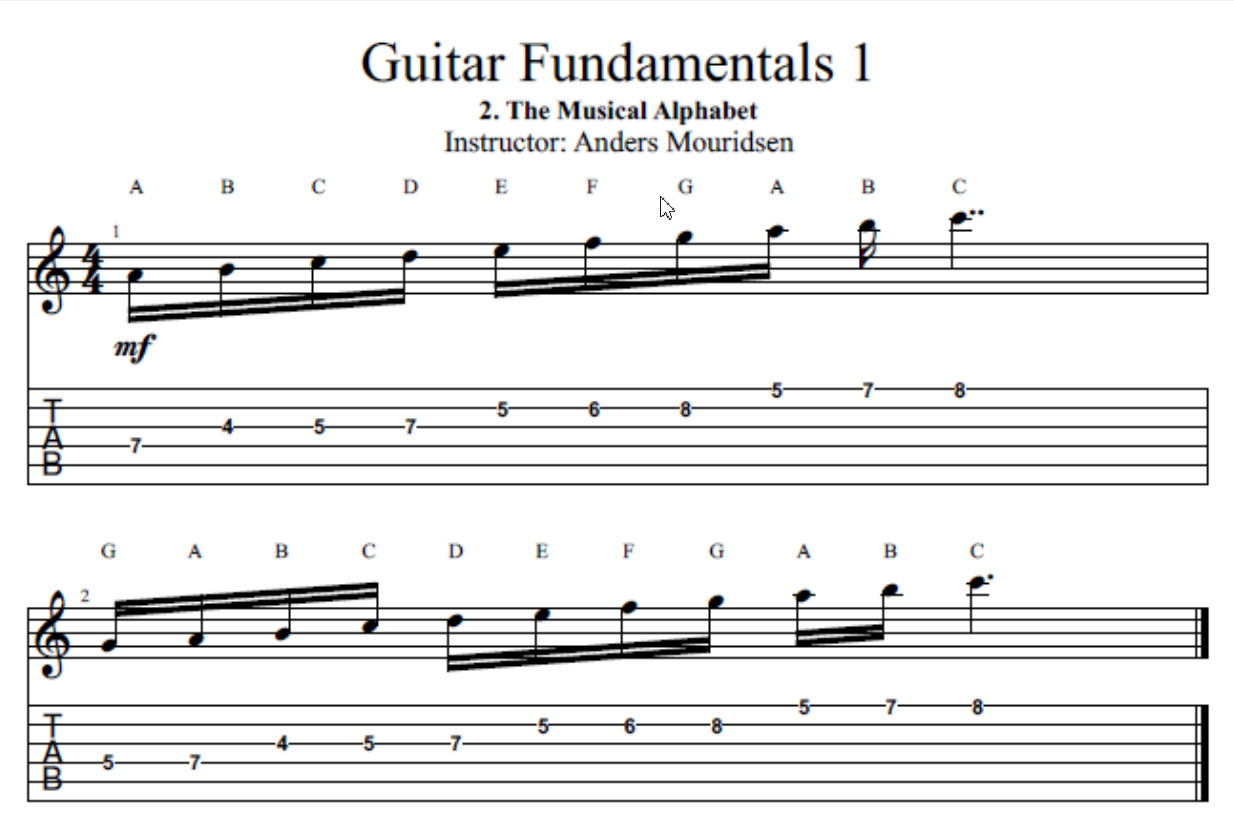
Here's where I'm having trouble. When I practice the scale thats in my original email, it's the typical do-ray-me-fah-so-lah-ti-do, you would expect, but then I come to the 2nd G, 5th fret, D string and it's like, where did this come from??? It sounds like a note that was just stuck in there as some kind of "filler" and then it takes of fine from there...I'm missing something?
Thanks,
DJ
No, you aren't missing anything. This is just an introduction to the idea that you can continue the scale or alphabet lower than the note you start on (or higher!). The scale extends for as far as the instrument goes.
Think of it like this: Anders shows you how to play these notes:
a-b-c-d-e-f-g-a
That's because those are the basic letters we use in music. Then he says, and as go higher in pitch on the guitar, the letters just start repeating:
a-b-c-d-e-f-g-a-(b-c) . . . and so on.
See the notes in parentheses are the same letters we already used but they are higher in pitch.
And we can also go below the first note, lower in pitch:
(g-)a-b-c-d-e-f-g-a-(b-c) . . . and so on.
See the G note is just a repeat, but it is lower in pitch that the other G.
The entire point here is that Anders is introducing you to the idea that we keep using the same 7 letters over & again all across the guitar, even though we go higher or lower in pitch. These are repeating octaves.
So on any music instrument you have:
a-b-c-d-e-f-g-(a-b-c-d-e-f-g)-a-b-c-d-e-f-g-(a-b-c-d-e-f-g)-a-b-c-d-e-f-g-(a-b-c-d-e-f-g) . . . and so on, for as low and high in pitch as it is possible to play on the instrument.
Anders is just showing you a little bit of how that works to get you started on the idea.
Make sense?
Christopher Schlegel
Guitar Tricks Instructor
Christopher Schlegel Lesson Directory