


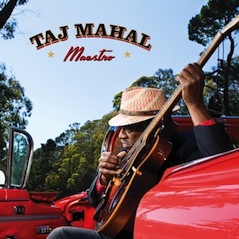
"I walk with the energy of music every day. I don't have to turn it on to hear it play"
Taj Mahal
Taj Mahal is an aural alchemist. Working with a steady blues base, he mixes various rhythms and styles, adding a pinch or two here, layering a style or two underneath, he massages it into his own distinct style and like the wizards of old, he delivers gold to the amazed.
Although he is considered by many to be the most prominent of the modern day blues men, Taj Mahal is a man who is difficult to pigeon hole. Despite the fact that he has made a name for himself as a supreme blues interpreter, primarily in acoustic Delta flavored blues, he has branched out and grabbed a hold of many different genres and incorporated them into his sound. There is little doubt that Taj Mahal was one of the first, if not the very first, to explore and promote 'world music' long before it became its own style.
Closing in on 68 years old, he sounds as powerful, rhythmic and as soulful as ever.
He was born Henry St. Claire Fredericks in Harlem in New York City in 1942 about the time of the Harlem Renaissance when African Americans were experiencing a revitalization of their culture and art. His father, Henry St. Claire Fredericks Senior was a noted jazz pianist and composer (who wrote scores for Benny Goodman and Ella Fitzgerald) and his mother, a gospel singing school teacher from South Carolina were both deeply devoted to music. Both of his parents encouraged him to indulge in their somewhat extensive record collection and did not stand in his way when he began to show interest in music. According to Taj, his father had a short wave radio that he would listen to as he was growing up and it was from this that he began to develop an ear for music from all over the globe. His parents set the young man up with classical piano lessons which only lasted a few weeks as shortly after starting it became clear that Taj had his own ideas about how he wanted to play.
While he was still a child, the family relocated to Springfield, Massachusetts. His father was beginning to develop his own business at this time when tragedy struck. Young Henry watched as his father flipped over a tractor in the family's back yard and was crushed. "I was so traumatized I couldn't do a full-on grieving, so I never spoke to anyone about it".
His mother returned to school and secured her Masters degree in early childhood education and married a Jamaican man by the name of Hughan Williams. By this time, when Henry was 13 years old, he had begun to take clarinet and trombone lessons but it was purely by chance that he began to pick up the guitar. Henry happened upon his step-fathers guitar sitting in a closet in the basement and Henry took it out and began to teach himself how to play, sitting in the basement plucking the strings with the teeth from a broken comb. For the most part, he is self-taught although he did briefly take lessons from a neighbor, Lynwood Perry, who happened to be the nephew of blues forefather, Arthur 'Big Boy' Crudup.
By the time he was in high school, Henry was playing several instruments including piano, guitar, clarinet and harmonica but none of them exceptionally well. Around this time, Henry found himself at a crossroads of sorts. His interest in music was matched by his love of farming and when he went off to college at the University of Massachusetts, he decided to major in animal husbandry with minors in veterinary science and agronomy. He had been working on a dairy farm since the age of sixteen and by the time he turned nineteen, he had worked his way up to farm foreman. 'I milked between thirty-five and seventy cows a day. I clipped udders. I grew corn. I grew Tennessee redtop clover. Alfalfa."
While at the University of Massachusetts, his stage name of Taj Mahal came to him in a dream about Ghandi, India and social intolerance. While in college, along with working his way into the Boston folk scene, Taj led a rhythm and blues band called Taj Mahal and The Elektras, which, according to those alumni of the college at that time, was a legendary party band at the school. Once he graduated, Taj decided that music was the direction he wanted to pursue and he left for Los Angeles to test the waters.
Shortly after arriving in Los Angeles, Taj Mahal hooked up with another legendary guitarist, Ry Cooder, and formed the short lived band, The Rising Sons. The band, with its eclectic interpretation of folk, blues and rhythm and blues, was quickly signed to a record contract with Columbia. Splitting their time between the studio and clubs, the band opened for several popular acts of the time including Otis Redding, the Temptations and Martha and the Vandellas. During this time, Taj Mahal was continuing his blues education by spending time with blues legends Howlin' Wolf, Muddy Waters, Junior Wells, Buddy Guy and Lightnin' Hopkins.
The Rising Sons recorded one album for Columbia but felt, after the release of one single, that the band was not commercially viable and shelved the album. (They did release the album in 1993, re-titling it as The Rising Sons Featuring Taj Mahal and Ry Cooder as part of their Legacy Series). The band dissolved shortly after the album went into the vault. Ry Cooder once said that the reason the band never really made it was because 'there were too many other good blues-rock bands that had come to the fore in the mean time'.
Despite the failings of The Rising Sons, Columbia felt that Taj Mahal had 'something' that would do well with the record buying public and kept him on the label for his solo effort. In 1968, Taj Mahal released his self-titled debut album. The album brought him mixed reviews but did bring him some national attention. His next album, The Natch'l Blues, continued the trend as Taj Mahal supported the disc with a tour of small clubs around the United States. A positive review of the album in Rolling Stone magazine (Taj Mahal 'is one of the most joyable and entertaining performers around') helped his career as well.
Giant Step / De Ole Folks At Home, released in November of 1969 saw the benefits of his touring with increased sales and exposure for him. It also marked a time when Mahal was becoming more involved in groups fighting for civil rights, giving benefit concerts for several groups. Along with his nascent political awareness, Mahal became increasingly aware and interested in roots music, both domestically and internationally.
Though out the Seventies, Mahal became increasingly more involved with other avenues of primarily African music; everything from Caribbean, West African to calypso, reggae and jazz. Bitten by the world music fervor, Mahal moved to Spain in 1970 and used the location as a launching pad for several excursions into Africa and the Middle East seeking out different styles of music. He also did several tours of Europe where he won a legion of fans in several countries. When he returned to the United States in 1971, aside from appearing at several music festivals, he scored and performed the soundtrack for the film Sounder (a film in which he appeared also).
In the mid-seventies, Mahal terminated his relationship with Columbia and signed with Warner Brothers. His first project under the WB label was writing the score for the film Brothers. His recording output for Warner Brothers revealed the extent of the influence world music had on Mahal's playing. He would still lay down some of the best country-style blues from a contemporary musician but the albums would be peppered with tracks infused with salsa, reggae and calypso.
Through the Eighties, Mahal was without a major record label contract but was far from inactive. He relocated to Hawaii, continued to record albums on various independent labels, recorded a children's album, Shake Sugaree, and participated with Pete Seeger and Bob Dylan to record Woody Guthrie and Leadbelly tracks for the Smithsonian Institute to help raise money to purchase the defunct Folkways record catalogue.
Mahal was not a man to sit idle and throughout the eighties and into the nineties, he found himself working on several projects from film scores, to recording albums, and scoring stage shows, all the while still jamming locally with his Hawaiian band, The Hula Blues Band. In 1991, he signed with Private Music and released Like Never Before and Dancing The Blues which included re-workings of several classic blues and R&B tunes, a few original tracks as well as a smoking duet with Etta James on 'Mockingbird'. Dancing The Blues earned Mahal a Grammy nomination. But it was his 1997 album, Phantom Blues, (that included work with Eric Clapton, Mike Campbell of The Heartbreakers and David Hildago of Los Lobos) that earned the veteran musician his first Grammy.
Although he has settled into the role as an elder statesman of the blues, Taj Mahal still records regularly and continues to tour regularly, often times with some rather unlikely bands. He has toured and worked with everyone from The Rolling Stones, Tom Petty and The Heartbreakers and The Black Crowes to Indian musicians Vishwa Mohan Bhatt and Narasimhan Ravikiran.
It looks like Taj Mahal has no intention of slowing down at any time in the near future. When he was once asked about the music he plays, Mahal said 'In the end, ultimately the music plays you, you don't play the music'.
Well said.
[FONT=Tahoma]"All I can do is be me ... whoever that is". Bob Dylan [/FONT]