

Three Notes and Endless Possibilities

 Get it for $20
 Lifetime Access

About the course
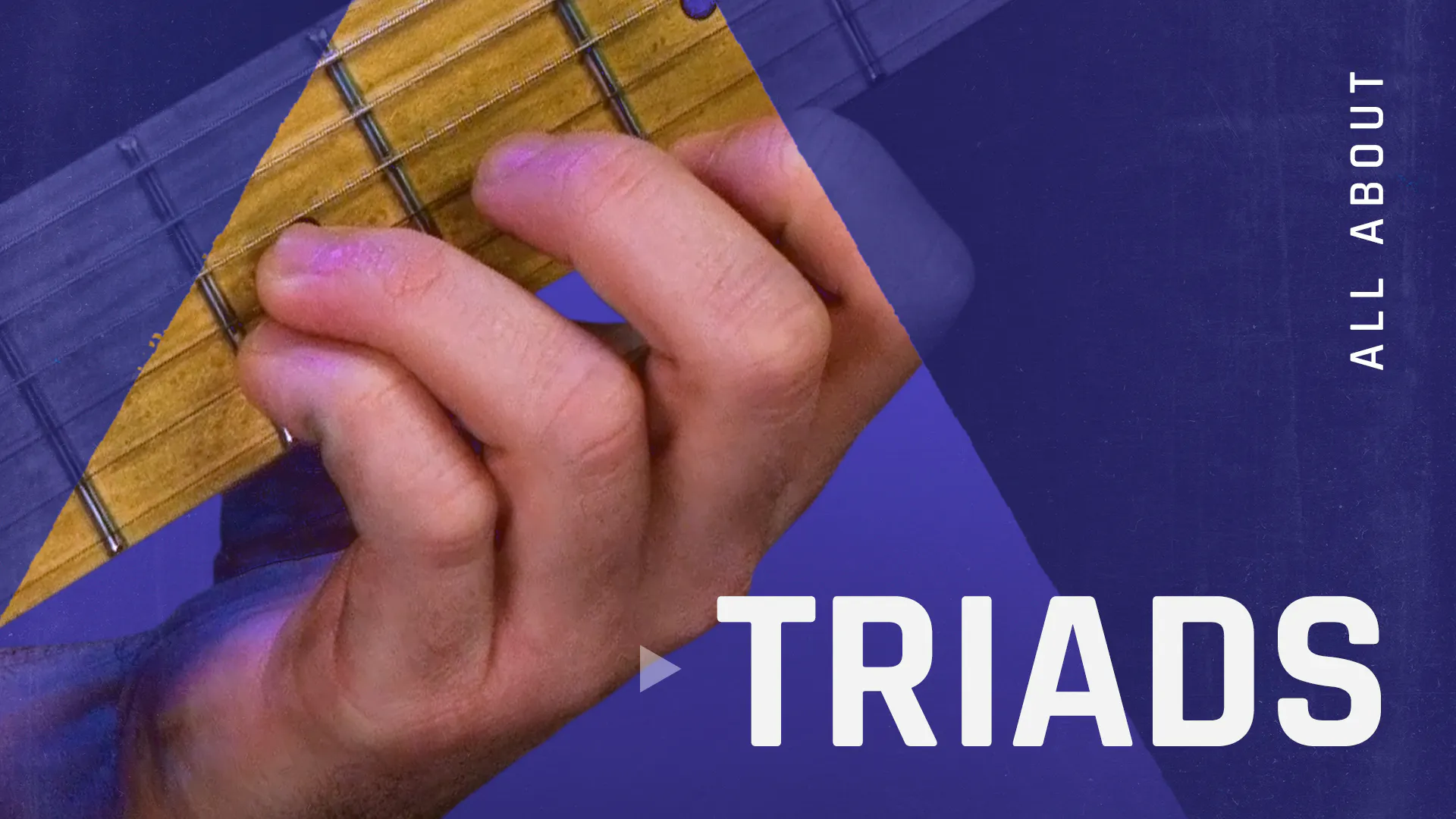
Triads are the foundation of many guitar chords and a key element in understanding harmony.
In this comprehensive course, we’ll dive into the basics of triads, which are chords made up of three notes.
We’ve included a set of tutorials focused on practicing these shapes across the entire fretboard, so that you can internalize the information at your own pace.
Also included are several more tutorials aimed at applying these powerful chord shapes.

Included In This Package:
By the end of this tutorial you should understand and be able to play basic triad chord shapes and their inversions in multiple fretboard locations. You should understand how chords are built from scales and the concept of triadic harmony or tertiary harmony.
In this section of Rock Guitar Level 2, we will focus on the concept of Major Triads and their inversions. A triad is a chord using 3 notes to create one overall sound. In many of the major chords you have previously learned from Guitar Tricks, their already exists triads in your musical vocabulary. Each chord we reference will have three major triads, and each of these triads is called an inversion. While each example in the lessons will have different shapes, each of them still remains the same chord. We will use the triads you already know, demonstrating their inversions from a D major chord, an A major chord, and an E major chord. We will take each lesson using string groups of three, and will follow each explanation with an example of those triads use in the rock guitar world.
We are going to shift our attention to the concept of minor chords and their inversions. Again, a triad is a chord using 3 notes to create one overall sound. Now matter what the shape, these chords all include the same notes and will create the same quality of sound. Shifting from major to minor, the only difference between minor triads and the major triads we learned in Chapter 1 is the lowering of one note, a half step (or one fret down the neck of the guitar.) We will again use triads you are already playing in the chords D minor, A minor, and E minor, also using the string grouping concept. Following each demonstration will be more examples of triads used in a rock guitar style.
In music theory the word triad refers to a group of three specific notes from a scale that form a chord. There are four basic types of triads in music. In this tutorial series we will take an introductory look at how to play all of them. Then we'll mix & match them in some musical examples.
When you play a full barre chord there are actually many more notes than you really need. In this tutorial we'll look at how to strip down your full barre-chords to smaller versions of each chord known as "triads" and how you can use those in your electric country rhythm playing.
In this tutorial we will use a backing track to systematically practice triad chords and their various inversion shapes on the E, A and D strings. Among the goals of this tutorial are integrate the theory of chord voicings and voicing motion with practicing and visualizing the specific shapes of triad chord inversions.
In this tutorial we will use a backing track to systematically practice triad chords and their various inversion shapes on the A, D and G strings. Among the goals of this tutorial are integrate the theory of chord voicings and voicing motion with practicing and visualizing the specific shapes of triad chord inversions.
In this tutorial we will use a backing track to systematically practice triad chords and their various inversion shapes on the D, G and B strings. Among the goals of this tutorial are integrate the theory of chord voicings and voicing motion with practicing and visualizing the specific shapes of triad chord inversions.
In this tutorial we will use a backing track to systematically practice triad chords and their various inversion shapes on the G, B and E strings. Among the goals of this tutorial are integrate the theory of chord voicings and voicing motion with practicing and visualizing the specific shapes of triad chord inversions.
In this tutorial we will use a backing track to systematically practice minor triad chords and their various inversion shapes on the E, A and D strings. Among the goals of this tutorial are integrate the theory of chord voicings and voicing motion with practicing and visualizing the specific shapes of triad chord inversions.
In this tutorial we will use a backing track to systematically practice minor triads and their various inversion shapes on the A, D, & G strings. Among the goals of this tutorial are integrate the theory of chord voicings and voicing motion with practicing and visualizing the specific shapes of triad chord inversions.
In this tutorial we will use a backing track to systematically practice minor triad chords and their various inversion shapes on the D, G & B strings. Among the goals of this tutorial are integrate the theory of chord voicings and voicing motion with practicing and visualizing the specific shapes of triad chord inversions.
In this tutorial we will use a backing track to systematically practice minor triads and their various inversion shapes on the G, B & E strings. Among the goals of this tutorial are integrate the theory of chord voicings and voicing motion with practicing and visualizing the specific shapes of triad chord inversions.
Anders shows how basic triads can be used a basic introduction to playing solos and lead parts in a Country context.



Three Notes and Endless Possibilities
 Get it for $20
 Lifetime Access


