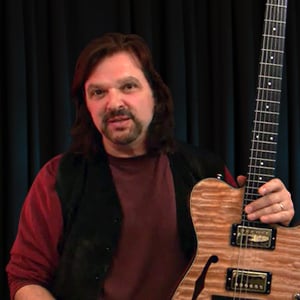
- Instructor Since: December 16th 2008
- Total Lessons: 24
- Latest Lesson: The Blues Scale, Lesson 1: Introduction
Joe Delia
Joe is a skilled and experienced rock guitarist, producer, and instructor living on the perimeter of greater Los Angeles. A native of Syracuse, New York, Joe first took up guitar at age 7. He would use his older brother's guitar, and learn from seeing his brother play.
Joe started playing in bands early on too, around the 6th grade. Eventually he gigged around central New York steadily in his late teens, later moving to Taos New Mexico and gigging around the local scene.
Moving to the San Francisco bay area for a spell, Joe performed in major clubs doing original music. He made the leap to L.A. in the big hair 80s, showcasing original music there at The Roxy, The Whiskey, and The Troubadour. His music has brought him to cross paths and work with Al Schmitt, Jim Gaines at the Record Plant, Joel Stoner, and others.
Joe has written music for TV including Baywatch, Walker Texas Ranger, various other shows through producer Christopher Stone, and other media including Sega video games. His influences range from Yes (Steve Howe) and the Moody Blues, to Cat Stevens, Jimi Hendrix, Crosby Stills and Nash, and the Beatles.
Joe has been a private guitar teacher throughout his career, and currently has 40 students per week.
The Jimi Hendrix Style: Chord Embellishments
The Blues Scale, Lesson 1: Introduction
The Jimi Hendrix Style: Pentatonic Scale & Chords
Exploring the topic of Hendrix-like embellishments even further, this lesson explains where all of these extra notes come from: the notes in the surrounding pentatonic scales, whether they be major or minor. This technique can help you add in "fills" and keep your chord playing sounding lively like Jimi Hendrix's.
Bending & Vibrato, Lesson 1: Introduction
The Blues Scale, Lesson 2: On One String
The Blues Scale, Lesson 3: In Open Position
The Jimi Hendrix Style: Parallel Octaves
Parallel octaves are by no means a new musical idea, but Hendrix used this technique in his rock playing to create a beautiful, lush sound. It effectively blends the best aspects of rhythm guitar and a lead melody line. So the next time you are trying to decide whether to play rhythm or lead during a section, try this cool Hendrix-y technique out. It can be used in many styles, not just blues rock.
The Blues Scale, Lesson 4: Diagonal
In this lesson we'll learn how to play the blues scale across the neck diagonally. This will help you understand how to move your playing up and down the neck, as well as across the neck. That way, your playing isn't stuck in just one place -- you can move it anywhere!
Bending & Vibrato, Lesson 2: Up & Down Bends
Bending & Vibrato, Lesson 3: Pre-Bends
The Jimi Hendrix Style: String Bending
The Blues Scale, Lesson 5: Major 3rd Slurs
The Jimi Hendrix Style: Sliding Chord Shapes
Hendrix didn't only slide single notes up and down the neck. He also slid his basic first-position chord shapes around while leaving his open strings ringing. This lesson will show you the basic idea on how to do this. You can try using these chords on different frets for different levels of harmonic tension. This can at times give your playing an "exotic" flavor, which is something that many guitarists were influenced by in the 60's. The droning of the strings can sometimes invoke the sound of an indian sitar.
The Jimi Hendrix Style: Hammer Ons, Pull Offs
Hammer-Ons and Pull-Offs were central to the Jimi Hendrix style. These simple tricks allow for a more fluid "slur" between the notes, adding style and variation to your articulation. If you watch old videos, you might notice that sometimes Jimi's picking hand was doing everything BUT picking the notes. That is because he was a master of legato, sometimes letting his fretting hand do all the work. This would leave his picking hand free to work the whammy bar, or to just swing it around for dramatic emphasis (never underestimate the power of visual performance!). This techniq...
The Blues Scale, Lesson 6: Sliding The Blues Note
The Jimi Hendrix Style: Wah Pedal
Artists on the level of Jimi Hendrix don't just use the wah pedal to make funny noises (although they do their fair share of that) -- they use it to add personality and additional syllables to their melodies and rhythms. It's easy to just pump it all the way up and down on each quarter note, but there is a lot more to it than that. You can and should practice all of the subtleties to this seemingly simple pedal and use it to add a new level of organic energy to your playing.
The Jimi Hendrix Style: Sharp 9 Chords
This is the chord that Jimi Hendrix is known for. It's the chord used in Purple Haze, a song that every guitarist learns at one point in their career. Out of everything Hendrix did in his short career (and he did a lot), this one chord alone could be his most defining musical sound. Even though it was not of his own invention, when played on a grungy strat, it is instantly recognizable as "The Hendrix Chord." This lesson will show a few ways to play it.
The Blues Scale, Lesson 7: Putting It All Together
The Jimi Hendrix Style: Sliding
Sliding is another legato technique that Hendrix used a lot. In combination with hammer-ons, pull-offs, and all the different ways of picking, you can add a lot of variety and personality to your melodies, making them unique. (One bit of advice: don't push down on the string too hard while sliding up, or you will make your notes go flat.)
The Jimi Hendrix Style: Unison Bends
A unison bend is a way of playing unisons (two notes of the same pitch) via bending one of the notes. This can thicken up your melody considerably, adding a dirty texture and passionate whine. Hendrix used this quite a bit to evoke dissonance, since the two notes begin out of tune and are slowly brought to the same pitch as he bent them. This is very effective for adding personality and grit to what would otherwise be a simple melodic line.
Bending & Vibrato, Lesson 4: Bend and Choke
Bending & Vibrato, Lesson 5: Bend One, Not The Other
Now we will talk about how to Bend One And Not The Other. This means that we hold one note in pitch while bending the other to create either a unison or harmony. It is important to consider what scale you happen to be using for this technique to be effective within a musical passage.